
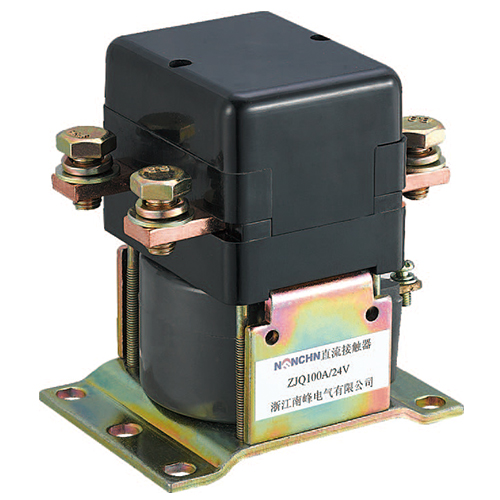
You're working on a battery-powered machine — a forklift, a winch, an electric car — and you need a switch that can handle high DC current without welding shut. A DC Contactor does exactly that: it uses a coil to pull contacts together, and when the coil de-energizes, the contacts open and break the circuit. Unlike a manual switch, a contactor can be controlled remotely and handles the arcing that comes with DC loads. The ZJQ100A from Zhejiang Nanfeng Electric is a single-pole, normally-open contactor rated for 100A and DC voltages up to 80V. This article covers how it works, what the key ratings mean, and how to pick the right coil voltage for your application.
How Does a DC Contactor Actually Switch Power?
The Coil Pulls, the Contacts Carry
A contactor has two circuits: a control circuit and a power circuit. The control circuit energizes the coil, which creates a magnetic field that pulls the movable contact against the fixed contact. That closes the power circuit and lets current flow to your load. When you cut power to the coil, a spring pushes the contacts apart and the circuit opens.
The ZJQ100A uses a single set of normally-open contacts. That means the power circuit stays open until the coil is energized. For battery-powered equipment, this is a safety advantage — if the control circuit loses power, the contactor opens and disconnects the load. You don't need to rely on a manual disconnect to isolate the battery.
The coil itself is designed for continuous duty, so it can stay energized for long periods without overheating. Pickup voltage is ≤70% of the rated coil voltage, which means the contactor will pull in reliably even if battery voltage sags under load. Release voltage sits between 5% and 40% of rated voltage, giving you a clean drop-out threshold.
What Happens During Switching
When the contacts close, they carry the full load current. The ZJQ100A handles 100A continuously with a voltage drop of ≤80mV at that current. Low voltage drop means less heat at the contact interface and more efficient power transfer to your load.
When the contacts open, an arc forms as the current tries to keep flowing across the gap. DC arcs don't self-extinguish the way AC arcs do at zero crossings, so DC contactors need robust arc management. The ZJQ100A uses AgCuO(10) contact material, which resists arc erosion and welding. The instantaneous maximum closing current is 7 times the rated current for up to 1 second, giving you headroom for inrush loads like motor startup.
What Do the Ratings and Specs Tell You?
Reading the Numbers That Matter
The ZJQ100A is rated for DC voltages up to 80V and currents up to 100A. That covers 12V, 24V, 48V, and 72V battery systems commonly found in electric forklifts, golf carts, winches, and electric vehicles. The contact arrangement is a single normally-open pole, so you're switching one side of the DC circuit.
Mechanical life reaches at least 300,000 cycles, and electrical life hits at least 20,000 cycles at rated load. Those numbers tell you the contactor is built for repeated switching, not just occasional use. Temperature rise on the outgoing terminals stays ≤65K, and coil temperature rise is ≤85K. The enameled wire insulation is Class B, rated to 130°C.
The contactor mounts freely — there's no required orientation. That flexibility matters when you're fitting components into a crowded battery compartment or under a vehicle chassis.
| Parameter | ZJQ100A Specification |
|---|---|
| Contact type | One set of NO (normally open) |
| Rated voltage of contacts (DC) | ≤80V |
| Rated current of contacts | 100A |
| Instantaneous max closing current | 7Ie, ≤1s |
| Voltage drop on contacts | ≤80mV (at 100A) |
| Coil voltage options (DC) | 12V, 24V, 48V, 72V, 80V |
| DC power consumption of coil | ≤38W |
| Pickup voltage (DC) | ≤70% Us |
| Release voltage (DC) | ≥5% Us; ≤40% Us |
| Pickup time | ≤50ms |
| Release time | ≤50ms |
| Contact material | AgCuO(10)/Cu |
| Insulation resistance | ≥100 MΩ |
| Dielectric withstand voltage | 1500V, 1min, no breakdown |
| Mechanical cycles | ≥30,000 |
| Electric cycles | ≥20,000 |
| Working duty | Continuous operating duty |
| Protection grade | IP50 |
| Working temperature | -25°C to +55°C |
| Mounting altitude | ≤2 km |
Which Coil Voltage Fits Your Battery System?
Matching the Coil to Your Supply
The coil voltage has to match your control circuit, not your main power circuit. In many battery-powered machines, the control voltage is the same as the battery voltage — a 24V system uses a 24V coil, a 48V system uses a 48V coil. But if your control circuit runs through a DC-DC converter, you can use a lower coil voltage and still switch a higher-voltage power circuit.
The ZJQ100A offers coil options at 12V, 24V, 48V, 72V, and 80V. Coil resistance varies by voltage: a 12V coil measures around 3.8Ω, a 24V coil around 17.4Ω, and a 48V coil around 69.5Ω at 20°C. Higher coil resistance means lower holding current, which translates to less heat and less drain on your battery when the contactor is energized.
If you're not sure which coil voltage to pick, start with the nominal voltage of your battery pack. A 48V lead-acid pack actually sits around 50–52V when fully charged, so a 48V coil is the right match. Don't use a 24V coil on a 48V system — the coil will overheat and fail.
Where Does This Contactor Fit in Real Equipment?
Battery-Powered Machines That Need Reliable DC Switching
The ZJQ100A is built for equipment that runs on battery power and needs a remotely controlled, high-current switch. That covers a lot of ground:
-
Electric forklifts — switching traction motor power and hydraulic pump circuits
-
Electric winches — controlling forward and reverse motor direction through separate contactors
-
Battery-powered vehicles — main power disconnect and motor controller isolation
-
Excavators — switching auxiliary DC circuits on compact electric models
-
Vehicle air conditioners — controlling compressor clutch power in off-highway equipment
-
Golf carts and utility vehicles — main contactor for motor and accessory circuits
In each case, the contactor gives you a way to switch high DC current without running heavy cables to a manual switch. The coil draws ≤38W, so the holding current is modest compared to the load current it controls. And because the contactor mounts freely, you can position it close to the battery or the load to minimize cable length.
A DC Contactor like the ZJQ100A from Zhejiang Nanfeng Electric also handles vibration and temperature swings that come with vehicle-mounted equipment. The working temperature range spans -25°C to +55°C, and the contactor tolerates sine shock at 2.5g from 5 to 50 Hz plus impact at 50g for 11ms. That's the kind of mechanical ruggedness you need when the contactor is bolted to a moving machine.
What Questions Come Up Before Installation?
Can I use this contactor for AC loads?
No. The ZJQ100A is designed for DC circuits with a maximum contact voltage of 80V DC. AC contactors use different arc management because AC current crosses zero twice per cycle and the arc extinguishes naturally. A DC contactor doesn't have that zero-crossing advantage, so using it on an AC circuit can lead to arcing, overheating, or contact failure.
How do I wire the coil and the contacts?
The coil terminals are marked separately from the contact terminals. Connect your control voltage to the coil terminals — polarity matters on DC coils, so check the terminal labels or the wiring diagram. The contact terminals carry the load current. For the ZJQ100A, the outgoing terminal on the contact side uses an M8 stud with a maximum torque of 7.0 N·m, and the coil terminal uses an M5 stud with a maximum torque of 2.5 N·m. Over-torquing can crack the housing or strip the threads.
What does IP50 protection mean for my installation?
IP50 means the contactor is protected against dust ingress but not against water. The "5" rating means dust can't enter in sufficient quantity to interfere with operation. The "0" means no water protection. If your installation sees splashes, washdown, or rain exposure, you'll need to mount the contactor inside an enclosure that provides the water protection. For dry compartments in vehicles and equipment, IP50 is adequate.
How do I pick between 12V, 24V, 48V, and 72V coil options?
Match the coil to your control voltage. If your machine has a 24V electrical system and you're switching the main battery circuit directly, use a 24V coil. If you have a separate control voltage from a DC-DC converter, use that voltage. The coil resistance table in the specifications helps you calculate holding current: at 24V with a 17.4Ω coil, holding current is roughly 1.4A, which is manageable for most control circuits.
Let's Spec the Right Contactor for Your Circuit
Tell Us Your Voltage and Current
A DC Contactor gives you remote, high-current switching that manual disconnects can't match. The ZJQ100A from Zhejiang Nanfeng Electric handles 100A at up to 80V DC, comes with coil options from 12V to 80V, and carries IP50 protection with a continuous duty rating. If you're building or servicing battery-powered equipment and need a single-pole contactor that won't quit, get in touch with our team — tell us your battery voltage, load current, and control circuit voltage, and we'll help you confirm the right coil specification and mounting arrangement.