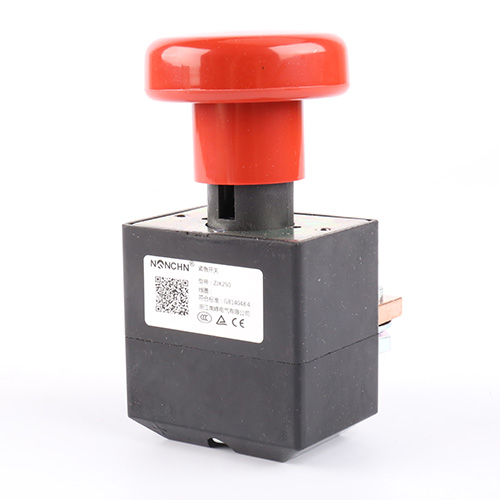

You're on a battery-powered forklift or an electric vehicle, and something goes wrong — a short circuit, a runaway motor, smoke from the battery compartment. The operator reaches for the red mushroom head and pushes. That single action has to disconnect the entire DC power system before the fault spreads. An Emergency Switch is the component that makes that happen, and the ZJK300A from Nanfeng Electric is built for DC systems up to 80V and 300A. This article explains how the switch works mechanically, what the contact design does under load, and what to verify when you're specifying one for mobile equipment.
What Happens Inside When You Push the Button?
Mechanical Limit Design and Bridge Contacts
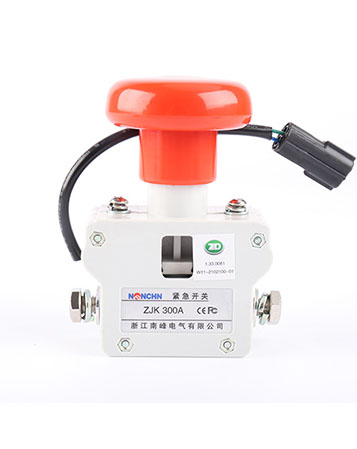
The ZJK300A uses a mechanical limit design with a red mushroom head actuator. When you press the button, a cam mechanism moves the contacts and locks them open. The switch uses one pair of bridge-type contacts, which means the contact structure bridges across the circuit path when closed and separates completely when opened.
The bridge contact design matters for DC switching. Unlike a single-break contact that opens at one point, a bridge contact opens at two points simultaneously. That doubles the arc gap and helps extinguish the DC arc faster. DC arcs don't self-extinguish at zero crossings the way AC arcs do, so the contact geometry directly affects how quickly and cleanly the circuit opens.
Manual Operation and Tactile Feedback
The switch is operated manually, and the force required to engage or disengage ranges from 20.0N to 50.0N for disconnect thrust and 20.0N to 100N for closed pull force. That force range is deliberate — it's high enough that the switch won't actuate from accidental contact or vibration, but low enough that an operator can push it firmly in an emergency.
The red mushroom head is a visual and tactile identifier. In a crowded battery compartment or a dashboard full of controls, the red mushroom shape stands out. The operator doesn't have to search for the right button under stress.
What Electrical Ratings Define the Switch?
Voltage, Current, and Short-Time Withstand
The ZJK300A is rated for a contact voltage of ≤80V DC and a continuous contact current of 300A. The instantaneous maximum closing current is 1200A for up to 1 second, which gives the switch headroom for inrush currents that occur when a motor starts or a capacitive load charges.
The voltage drop across the contacts is ≤80mV at 100A, which indicates a low-resistance contact interface. Lower resistance means less heat generated at the contact point under continuous load. The insulation resistance is ≥100 MΩ at DC500V, and the dielectric withstand voltage is 1500V at power frequency for 1 minute without breakdown.
| Parameter | ZJK300A Specification |
|---|---|
| Contact type | One pair of bridge type |
| Rated voltage of contacts (DC) | ≤80V |
| Rated current of contacts | 300A |
| Instantaneous max closing current | 1200A, ≤1s |
| Voltage drop on contacts | ≤80mV (at 100A) |
| Insulation resistance | DC500V, ≥100 MΩ |
| Dielectric withstand voltage | 1500V, 1min, no breakdown |
| Mechanical cycles | ≥2×10⁴ |
| Electric cycles | ≥1×10⁴ |
| Normal closing time | ≤100ms |
| Normal disconnection time | ≤50ms |
| Working duty | Continuous operating duty |
| Protection grade | IP50 |
| Working temperature | -25°C to +55°C |
| Contact material | AgCuO(10)/Cu |
How Does the Switch Handle Vibration and Temperature?
Shock, Vibration, and Mounting
Mobile equipment doesn't sit still. The ZJK300A is rated for sine shock at 2.5g from 5 to 50 Hz and impact at 50g for 11ms half-sine. Those ratings mean the switch can be mounted on a forklift, an excavator, or a vehicle chassis without the contacts chattering or the mechanism releasing under vibration.
The working temperature range is -25°C to +55°C, which covers outdoor operation in most climates and indoor industrial environments. The switch mounts freely — there's no required orientation — so it fits wherever there's space in the battery compartment or control panel.
Where Do Emergency Power Off Switches Get Installed?
Battery Vehicles, Forklifts, and Construction Machinery
The ZJK300A is designed for DC power systems in battery cars, electric forklifts, electric vehicles, excavators, and similar equipment. The common thread is a battery bank that stores enough energy to sustain a dangerous fault, and an operator who needs a way to kill that power instantly.
-
Electric forklifts — disconnect the traction battery if a fault develops in the motor controller or wiring
-
Battery-powered vehicles — cut the main DC feed to protect the battery pack and prevent electrical fires
-
Excavators and construction machinery — isolate the DC system when hydraulic or mechanical faults create electrical hazards
-
Electric vehicles — provide a manual disconnect point independent of the electronic control system
An Emergency Switch like the ZJK300A from Nanfeng Electric also handles the mechanical and electrical demands of continuous duty. The switch is rated for continuous operating duty, so it can stay in the closed position indefinitely while the equipment runs. The contact material is AgCuO(10) on a copper base, which resists arc erosion and welding under repeated operation.
What Do Engineers Check Before Specifying One?
Current, Voltage, and Mounting Clearance
Match the switch's rated current to the maximum continuous current of the DC system. The ZJK300A handles 300A continuously, with a 1200A short-time rating for inrush. If your system draws more than 300A continuously, step up to a higher-rated model in the ZJK series.
Check the voltage against the battery system's nominal voltage. The ZJK300A is rated for DC systems up to 80V. A 72V battery pack that charges to 84V would exceed that limit — verify the maximum system voltage, not just the nominal voltage. For higher-voltage systems, a different model in the series is required.
Mounting clearance matters because the switch uses a manual actuator. Leave enough space around the red mushroom head for an operator to reach it without obstruction. The switch mounts freely, but the actuator should face the operator's normal position for fastest access in an emergency.
What Questions Come Up About Emergency Disconnects?
What's the difference between an emergency switch and a regular disconnect?
A regular disconnect is designed for planned maintenance — you open it when the equipment is already stopped. An emergency switch is designed for unplanned events — you open it while the equipment is running and a fault is developing. The ZJK300A is built to interrupt the circuit under load, with a bridge contact structure that handles the arc that forms when a live DC circuit opens.
How much force does the button require?
The disconnect thrust is 20.0N to 50.0N, and the closed pull force is 20.0N to 100N. That range balances two needs: enough resistance to prevent accidental actuation, and low enough effort for an operator to push the button firmly and quickly in an emergency. The mechanical limit design locks the contacts open once the button is fully depressed, so the operator doesn't have to hold the button down.
Can the switch be mounted in any orientation?
Yes. The ZJK300A mounts freely, with no required orientation. That flexibility helps in battery compartments and vehicle chassis where space is limited and the switch has to fit around other components. The key constraint is actuator accessibility — the red mushroom head should be reachable without obstruction.
What maintenance does the switch need?
Inspect the actuator mechanism periodically for smooth operation. Check the contact terminals for tightness and signs of overheating. The contact material is AgCuO(10)/Cu, which resists arc erosion, but repeated high-current interruptions will eventually erode the contact surface. If the switch shows increased voltage drop or the actuator feels stiff, service or replace it. The mechanical life is rated at ≥2×10⁴ cycles, and electrical life at ≥1×10⁴ cycles.
Let's Match a Disconnect Switch to Your DC System
Share Your Voltage, Current, and Equipment Type
An Emergency Switch should match your DC system's maximum voltage, continuous current, and the mechanical environment of the installation. The ZJK300A Type Emergency Power OFF Switch from Nanfeng Electric handles ≤80V DC and 300A continuous, with 1200A short-time capability, a bridge contact structure, and a red mushroom actuator with a mechanical limit lock. It's built for battery vehicles, forklifts, electric vehicles, and construction machinery where a fast manual disconnect is the last line of defense. If you're specifying a disconnect for a DC power system, send us your system voltage and load current — we'll help you confirm the right model before you order.