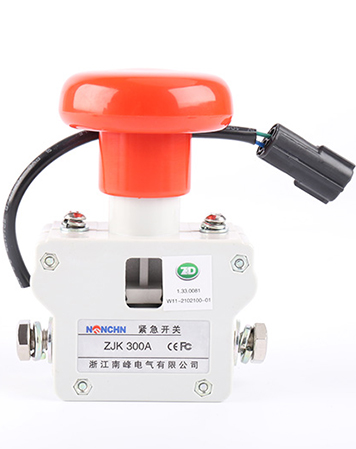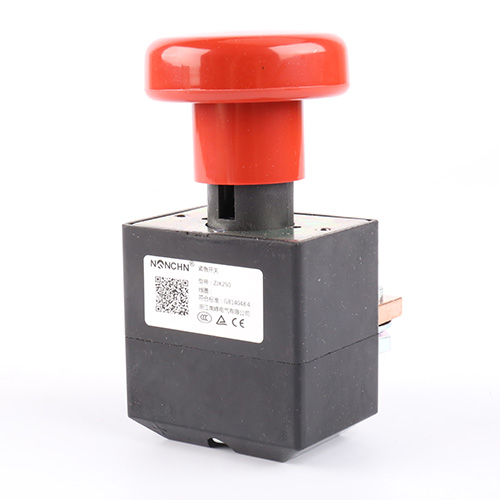

A driver reaches for the emergency cutoff when a forklift accelerates unexpectedly. Nothing happens. The red mushroom head is there, but the Emergency Switch doesn’t respond. The electric excavator fails to shut down at the end of a shift; the switch seems stuck, and the display stays powered. The operator hesitates, then yanks the red mushroom head again—still no click. This moment of failed response can turn a near‑miss into an accident or a routine shutdown into a frantic battery disconnect. An Emergency Switch that stops responding isn‘t always a catastrophic failure. Often it’s a fixable issue—debris, misalignment, or internal contamination that can be cleared on site. This guide walks you through the most common non‑responsive failure modes, how to diagnose each by feel and sound, and the step‑by‑step recovery that restores the switch without replacing the entire unit. All principles apply to the ZJK250A Type Emergency Power OFF Switch and the broader ZJK series.
The switch that didn‘t trip: patterns of failure
The ZJK series uses a mechanical limit design where a cam mechanism locks the contacts open once the red mushroom head is fully depressed. When this mechanism fails, the failure pattern tells you what broke.
Stuck actuator – won’t depress at all. The mushroom head resists downward movement, or moves only a few millimeters and stops. This usually means physical debris has entered the actuator bore—dust from a construction site, dried cleaning solution residue, or a dislodged internal component. In cold environments, ice can form inside the mechanism if moisture entered and froze overnight, preventing full travel of the pushrod.
Depresses but doesn‘t latch. The mushroom head goes down, but there’s no detent—it springs back up. The internal locking pawl has failed to engage. Common causes include a broken spring, a pawl that has worn smooth from thousands of cycles, or a misaligned cam follower.
Depresses and latches, but power remains on. The switch clicks, the head stays down, but the equipment runs. The mechanical limit mechanism has moved, but the internal bridge‑type contacts did not separate. This is the most dangerous failure mode because the operator believes the equipment is de‑energized but the circuit is still live. The failure often traces to contact welding from a high‑inrush event; AgCuO(10)/Cu contacts resist welding, but extreme overloads can still fuse them. It can also be caused by a broken internal mechanical link between the actuator cam and the contact carrier.
Latches and releases, but the power toggles erratically. The switch opens and closes intermittently. The internal cam has developed a flat spot, or the bridge‑type contacts have pitted unevenly, making the closure force inconsistent.
Feel and sound: diagnostic clues from your hand
Before you reach for tools, use your senses. The ZJK series has defined actuation forces: depress requires 20–30 N; reset pull requires 20–40 N. A switch in good health produces a crisp, audible “thunk” when it latches and a clean snap when reset. If the actuator moves without resistance, the return spring has failed. If the motion feels gritty or sticks partway, debris is inside the bore. If the latch feels soft or the detent is barely perceptible, the locking pawl is worn. For thermal abnormalities, place your hand on the switch after a long equipment run—if the body is uncomfortably hot, internal contact resistance is elevated, often a precursor to contact welding. The ZJK250A temperature rise limit is ≤65 K at rated current; if the housing exceeds that, the contacts are degrading.
Clearing debris and restoring smooth travel
For a stuck actuator that won’t depress, field cleaning often restores function without disassembly.
Procedure. Isolate the battery or main disconnect first—do not work on a live emergency switch. With power off, use a small soft brush (e.g., a toothbrush) to sweep debris from around the red mushroom head base and the crevices between the actuator and the housing. For compressed air, use low pressure (≤30 psi) to blow into the actuator bore; excessive pressure can lodge debris deeper. If the actuator remains stuck, apply a small amount of electrical contact cleaner (not oil or grease) around the stem, then work the actuator back and forth. Do not lubricate with standard oils—they attract dust and worsen the problem in the long term.
For ice blockage. In freezing temperatures, bring the equipment into a warm area or warm the switch gently with a heat gun set to its lowest temperature, keeping the nozzle at least 30 cm away and moving constantly. Never apply an open flame.
After clearing debris, manually depress and reset the switch several times to confirm smooth travel and proper latching.
Releasing welded contacts (with extreme caution)
When the switch latches but the power stays on, suspect welded contacts. The ZJK250A uses AgCuO(10)/Cu material rated for a 1000A surge for ≤1 second, but overloads beyond that can cause welding. Caution: This procedure assumes the battery has been physically disconnected or the main fuse removed. Never attempt this with the circuit live. With power fully removed, apply firm, steady pressure to the actuator beyond the normal travel stop. The mechanical limit design provides additional leverage at the end of the stroke; this extra force can break a minor weld without damage. If the switch still does not open, remove the switch from the equipment entirely. Hold the switch body in one hand and strike the red mushroom head sharply with a rubber or wooden mallet—not a steel hammer, which deforms the actuator. The shock often breaks the weld. After the weld is broken, cycle the switch several times to confirm full mechanical function. Replace the switch immediately if it shows evidence of arc damage (charring, melted plastic, or pitted contacts).
Verifying electrical function after repair
After clearing debris or breaking a weld, the switch’s electrical integrity must be confirmed before returning it to service.
Continuity test. Use a multimeter set to resistance mode. With the switch in the open (depressed) position, measure across the contact terminals—the reading should be infinite (open circuit). With the switch in the closed (released) position, the reading should be near zero. The ZJK250A has a specified contact voltage drop of ≤80 mV at 100 A. If the closed‑position resistance registers more than a few milliohms, the contacts are damaged.
Insulation test. If you have access to a 500V megger, measure insulation resistance between the contacts and ground (the metal mounting plate). The ZJK series requires ≥100 MΩ at DC 500V. A lower reading indicates moisture ingress or carbon tracking from arcing.
Mechanical cycle test. Manually actuate the switch through 20 complete cycles—depress, latch, reset. Listen for consistent clicks and feel for uniform resistance. The mechanical life is ≥20,000 cycles, but any grinding or inconsistency signals internal damage.
When to replace rather than repair
A field‑repaired emergency switch should be placed on a monitored replacement schedule. Replace the ZJK250A if any of the following conditions appear: visible arc burns, pitting, or melting on the contact surfaces; the actuator housing has cracked from impact; the switch has been submerged or heavily contaminated with conductive dust (carbon, metal filings); the switch has failed to open a live circuit more than once, indicating internal fatigue; the equipment is in a safety‑critical application (personnel transport, overhead lifting, public access machinery). In these cases, replace the entire switch—the cost of a new ZJK series emergency power‑off switch is negligible compared to the liability of a second‑life failure.
The ZJK250A: built for quick, positive disconnection
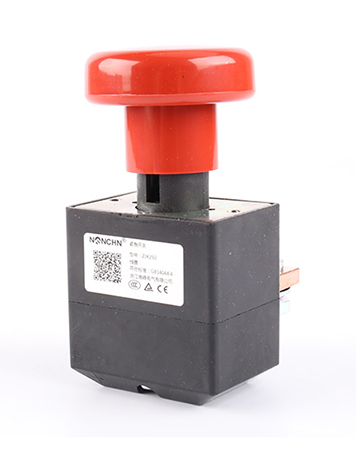
When reliability in an emergency matters, the switch’s mechanical design is its most critical feature. The ZJK250A Type Emergency Power OFF Switch from Nanfeng Electric uses a mechanical limit design with a red mushroom head actuator to control the switch on and off. Once depressed, the lock pawl engages and holds the contacts open until manually reset—no spring tension to relax, no drifting back to the closed position.
The ZJK250A is rated for 250A continuous at ≤80V DC, with a bridge‑type contact configuration and AgCuO(10)/Cu contact material for superior arc resistance. Instantaneous surge capacity reaches 1000 A for ≤1 second. The switch operates in temperatures from –25°C to +55°C, withstands 2.5g vibration across 5–50 Hz, and carries an IP50 dust‑protection rating. Electrical life exceeds 10,000 cycles, and mechanical life exceeds 20,000 cycles. The ZJK series is widely used on battery vehicles, electric forklifts, electric cars, excavators, and other DC power systems for emergency power disconnection. Nanfeng Electric (formerly Yueqing Nanhua Electrical Appliance Factory) specializes in medium‑load and heavy‑load DC components with certifications including 3C and ISO/TS16949.
For equipment owners concerned about emergency switch responsiveness, the ZJK250A‘s mechanical limit design and AgCuO(10)/Cu contacts provide a clear baseline: a crisp detent, a clean open, and repeatable function when it matters most.
→ Request a quote from Nanfeng Electric for the ZJK250A Type Emergency Power OFF Switch — Share your system voltage (≤80V DC), required current capacity (125A, 250A, or 300A), and environmental conditions (dust, moisture, freeze/thaw). Their technical team can recommend the right emergency power‑off switch configuration for your fleet.