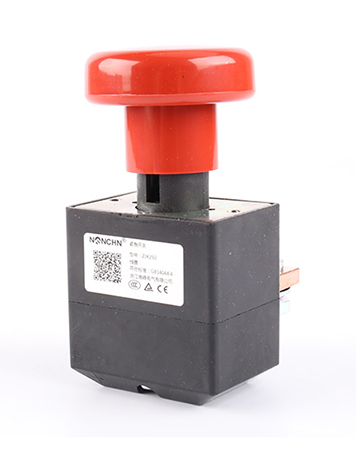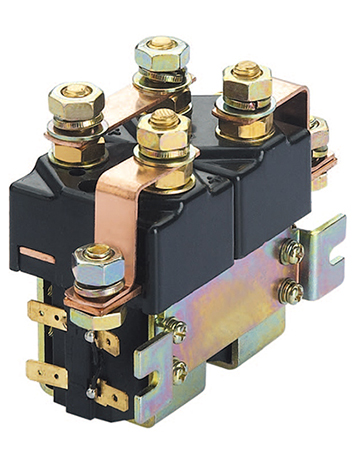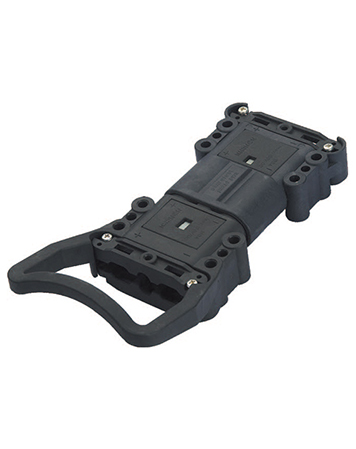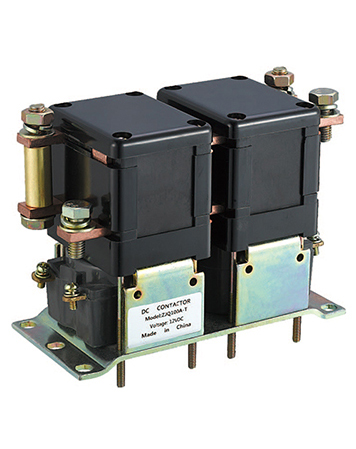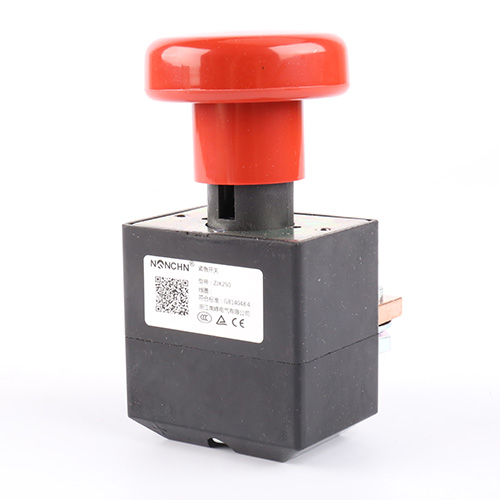

Imagine driving an electric forklift. The accelerator sticks. You’re heading toward a dock edge. Your hand instinctively slaps a big red button — and everything stops. That button is an Emergency Switch. It’s not a circuit breaker that trips automatically. It’s a mechanical device you activate on purpose when something goes wrong. Unlike a regular battery disconnect used for maintenance, an emergency switch is designed to interrupt current while the equipment is running at full load — a much harder job. This guide explains how it works, why the red mushroom head matters, and where these switches are essential.
The simple but critical function
An emergency switch sits between the battery and the rest of the system — motor controller, hydraulics, lights. Normally, it’s closed, carrying hundreds of amps. You push it, and it opens the circuit, killing all power. That’s the simple part.
The hard part is making sure it works every time, even under extreme conditions. A standard battery disconnect switch can weld its contacts shut if you try to open it under load. The emergency switch solves this with two features: high‑speed contact separation and contact materials that resist welding. The mechanical limit design forces the moving contact away from the fixed contact and holds it there until someone manually resets it. No accidental bounce‑back. No creeping closed from vibration.
Why the red mushroom head?
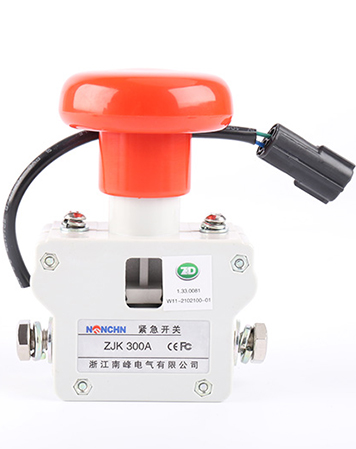
The design is deliberate. Red means “stop” in every industrial context worldwide. The large mushroom shape doesn’t require precise aim — you can hit it with a palm, a fist, or even an elbow in a panic. The ZJK series switches use a cam‑and‑detent mechanism that locks the actuator in the off position once pushed. To restart, you must twist or pull the head — an intentional action, not a bump.
Where you find emergency switches in the field
These switches are common anywhere battery‑powered equipment operates around people. Electric forklifts have them near the operator’s seat. Battery‑powered golf carts and personnel carriers mount them on the dashboard. Excavators and construction machinery include them for site safety. Electric cars often have a service disconnect — a variation of the emergency switch — for first responders.
In every case, the function is identical: cut the DC power instantly, regardless of load. The switch must handle the full battery voltage (often 48V, 72V, or 96V) and the maximum current the system can draw. For a large forklift lifting a heavy load, that can be 300 amps or more.
How much current can an emergency switch handle?
| Model | Continuous Current | Max Voltage (DC) | Surge Capability |
|---|---|---|---|
| Small vehicle switch | 125A | ≤80V | 600A for 1s |
| Medium equipment switch | 250A | ≤80V | 800A for 1s |
| Heavy machinery switch | 300A | ≤80V | 1000A for 1s |
The ratings matter because emergency switches aren’t sized for the normal operating current alone. They must survive the inrush current when something fails — a stalled motor, a shorted controller — while still opening reliably. A good emergency switch will clear a 1000A surge for a full second without welding its contacts.
What keeps the contacts from welding shut
When you open a switch under load, an arc jumps across the contacts. The arc temperature can reach several thousand degrees. If the contact material melts and fuses, the switch becomes a permanent conductor — the opposite of what you need in an emergency.
Quality emergency switches use contact materials specifically chosen for arc resistance. Silver‑copper oxide composites, often designated AgCuO(10)/Cu, are a common choice. The silver conducts well; the copper oxide provides thermal stability and resists welding. The bridge‑type contact design also helps — instead of a single point of contact, the bridge distributes the arc over a larger area, reducing local melting.
Even with the best materials, emergency switches have a finite electrical life. After a certain number of full‑load disconnects — typically 10,000 cycles — the contacts erode and the switch should be replaced. But in most equipment, the emergency switch is rarely used. That’s fine. It’s there for the one time you need it.
What to check before buying an emergency switch
Not all emergency switches are equal. Here’s what to look for on the spec sheet:
Mechanical limit design. Some cheap switches rely entirely on spring force to hold the contacts open. Vibration can cause them to creep closed. Look for a positive mechanical lock — a cam and detent that holds the actuator in the off position regardless of spring condition.
Contact material. If the spec doesn’t tell you what the contacts are made of, be suspicious. AgCuO, AgSnO₂, and AgCdO are all proven arc‑resistant materials. Avoid switches that only say “silver alloy” without specifics.
Voltage and current ratings. DC is harder to interrupt than AC. A switch rated for 300A AC might fail at 100A DC. Make sure the rating is explicitly for DC and matches your system voltage.
Terminal type and size. If you’re carrying 300A, you need M8 or larger terminals. Undersized terminals overheat and loosen over time.
Real‑world scenarios: when the button saves the day
Scenario one: A forklift in a warehouse has a throttle potentiometer failure. The truck accelerates unexpectedly toward a rack of pallets. The operator hits the emergency switch. The motor stops three feet from impact. Damage: none. Injury: none.
Scenario two: An electric excavator’s hydraulic pump seizes. The motor draws locked‑rotor current — over 800 amps. The main contactor might weld shut if the operator tries to turn it off with the key. But the emergency switch is designed for exactly this condition. It opens, clearing the arc, and the pump stops before the hydraulic lines burst.
Scenario three: A first responder arrives at an electric vehicle crash. High‑voltage cables are exposed. The emergency disconnect — often a removable fuse or a dedicated switch — cuts battery power to the entire vehicle, allowing safe extrication.
In all three cases, the switch does nothing 99.9% of the time. That 0.1% is why it exists.
How to test an emergency switch without destroying it
You should test emergency switches periodically, but testing at full load is impractical and dangerous. Instead:
-
With the equipment off, push the switch. You should feel a positive detent. The actuator should stay in the off position.
-
Measure continuity across the contacts. It should read open (infinite resistance).
-
Reset the switch. Measure continuity again. It should read closed (near zero resistance).
-
Listen for the snap of the mechanism. A sluggish return suggests worn springs or binding.
If the switch fails any of these bench tests, replace it. Don’t wait for a real emergency to find out it doesn’t work.
When an emergency switch is not enough
An emergency switch cuts power, but it doesn’t solve every problem. If a motor is mechanically jammed, cutting power stops it from burning up — but the jam remains. If a hydraulic line is already burst, cutting power stops the pump, but the fluid is already on the floor. Emergency switches are part of a safety system, not the whole system.
They also don’t replace fuses or circuit breakers. A fuse protects against sustained overloads and short circuits. A circuit breaker can be reset automatically. An emergency switch is for operator‑initiated shutdown in abnormal conditions. Use the right device for each role.
The company that builds these for heavy industry
One manufacturer that has specialized in this field is Zhejiang Nanfeng Electric Co., Ltd. (formerly Yueqing Nanhua Electrical Appliance Factory). Their ZJK300A Type Emergency Power OFF Switch is designed for the demands of electric forklifts, battery vehicles, tractors, excavators, and construction machinery. The ZJK series uses the mechanical limit and red mushroom head design described throughout this guide, with AgCuO(10)/Cu bridge contacts and ratings up to 300A at ≤80V DC.
Nanfeng Electric integrates production, R&D, and manufacturing, with a reputation for long service life, simple maintenance, and compact size. Their ZJK series is available in 125A, 250A, and 300A versions, with surge withstand capabilities of 600A, 800A, and 1000A respectively. For applications requiring reliable emergency disconnection in rough environments — forklifts bouncing over warehouse floors, excavators working in dust and vibration — these switches are a common choice.
[Request a quote from Nanfeng Electric for the ZJK300A Type Emergency Power OFF Switch] — Share your equipment type (forklift, EV, excavator), system voltage (48V/72V/96V), and maximum expected current. Their technical team will recommend the correct model and help with installation guidance.