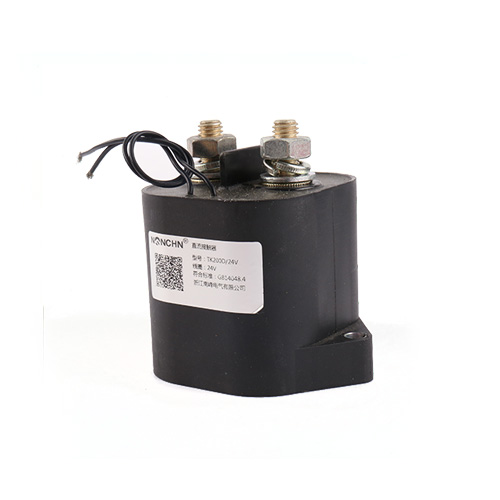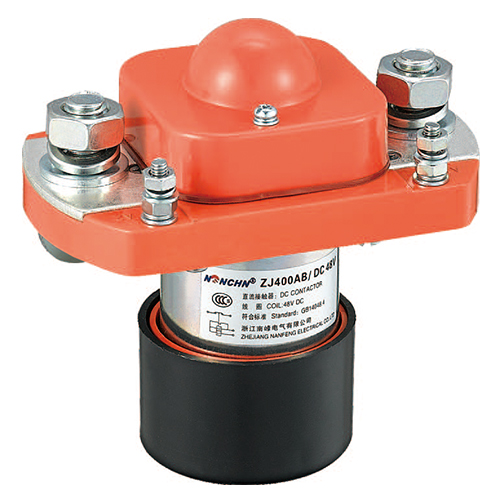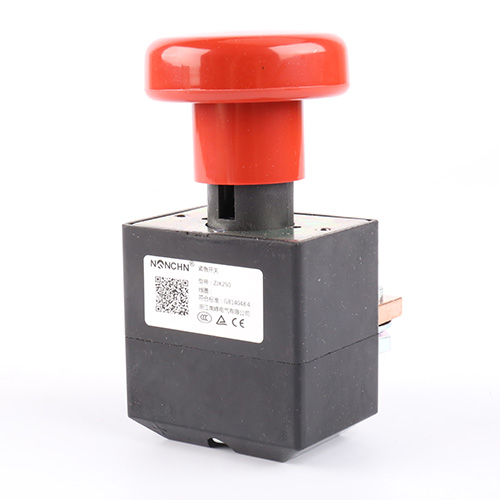

You're designing a power system for an electric forklift or an industrial winch. The battery delivers high current, the motor demands reliable switching, and a failed component means downtime. A mechanical switch won't last. A standard AC relay won't work. You need something built for DC.
A DC contactor is the answer — a heavy-duty switching device designed specifically for direct current circuits. Unlike AC contactors, DC contactors must handle the challenge of DC arcs, which don't self-extinguish the way AC arcs do. This guide covers what makes DC contactors different, where they're used, and how to choose the right one for your equipment.
Built for the brutality of DC
DC circuits present challenges that AC circuits don't. A DC contactor is engineered to handle those challenges reliably.
DC arcs don't go out on their own
When a contact opens under load, an arc forms. In AC circuits, the current crosses zero 100 or 120 times per second, giving the arc a natural extinction point. DC current never crosses zero — the arc continues until the contacts are far enough apart to extinguish it. That means DC contactors need larger contact gaps, faster opening speeds, and arc chambers designed to stretch and cool the arc.
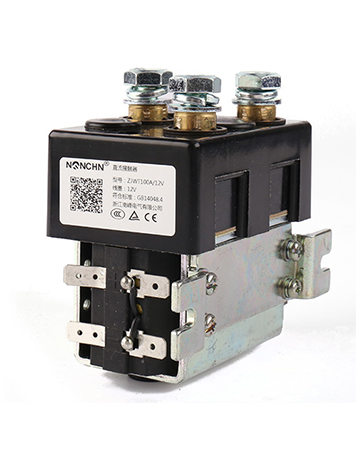
The ZJWT100 series is built with this in mind. With a rated voltage up to 48V DC and current capacity of 100A, it's designed for the demanding switching conditions of DC power systems. The contact gap and arc chamber are engineered to extinguish the DC arc reliably, cycle after cycle.
Contacts that don't weld shut
DC arcs generate high temperatures at the contact surface. Soft metals like copper or silver can weld together under sustained arcing. DC contactors use contact materials — typically silver alloys with tungsten or cadmium oxide — that resist welding and erosion. The result: longer contact life and more reliable switching.
300,000 cycles — and still going
The ZJWT100 series offers mechanical life of 300,000 cycles or more, with electrical life rated for thousands of operations at full load. For equipment that cycles frequently — electric vehicles, forklifts, winches — that durability translates into less downtime and lower maintenance costs.
Where you'll find them
DC contactors are found wherever high-current DC loads need to be switched reliably. The list is broad and growing.
Forklifts, EVs, and everything that moves
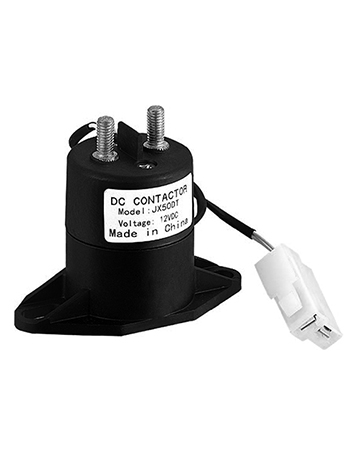
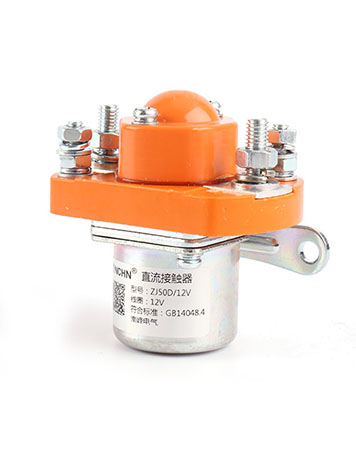
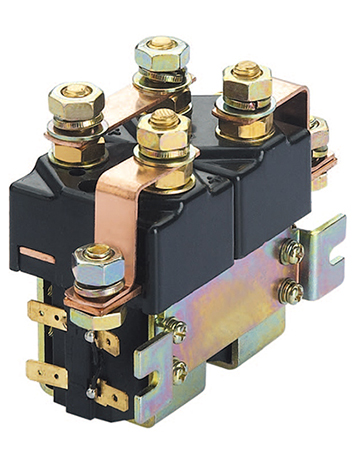
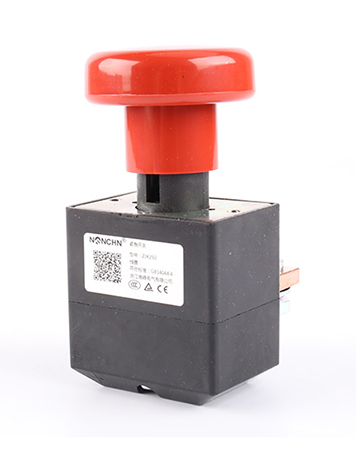
Electric forklifts, pallet trucks, and light electric vehicles all rely on DC contactors for power control. The ZJWT100 series is commonly used in these applications, switching battery power to traction motors and hydraulic systems. In forklifts, reversing contactors control motor direction — forward and reverse — with a single component.
Winches, hoists, and heavy pulls
Electric winches and hoists draw high current at low voltage. The DC contactor must handle the inrush current of a stalled motor while providing reliable switching under load. The ZJWT100 series handles these conditions with a rated current of 100A and the ability to interrupt high DC loads.
Battery banks and solar storage
Battery banks, solar storage systems, and UPS systems all use DC contactors for power distribution and protection. In these applications, the contactor may switch between charging and discharging modes, or isolate the battery in fault conditions.
Golf carts and light EVs
Electric vehicles, including golf carts and light utility vehicles, use DC contactors for main power switching and motor control. The coil voltage options — 12V, 24V, 48V, 72V — cover the range of common battery systems.
Below is a quick reference table for ZJWT100 series specifications:
| Specification | ZJWT100 Series |
|---|---|
| Rated voltage | ≤48V DC |
| Rated current | 100A |
| Coil voltage options | 12V, 24V, 48V, 72V DC |
| Mechanical life | ≥300,000 cycles |
| Electrical life | ≥20,000 cycles (DC-1) |
| Contact voltage drop | ≤100mV |
| Dielectric strength | 1000V AC for 1 minute |
| Operating time (pick-up) | ≤30ms |
| Operating time (drop-out) | ≤30ms |
Getting the coil voltage right
The coil voltage determines how the contactor is controlled. Selecting the wrong voltage leads to unreliable operation or coil failure.
Match the coil to your system
The ZJWT100 series is available with coil voltages of 12V, 24V, 48V, and 72V DC. Choose the voltage that matches your control system — typically the same as the battery voltage in vehicle applications. A 12V coil on a 48V system will burn out immediately. A 48V coil on a 12V system won't pull in.
Pick-up, drop-out — know the numbers
The cold pick-up voltage (the minimum voltage required to close the contactor) is typically no more than 66% of rated coil voltage. The drop-out voltage (the voltage at which the contactor opens) is typically no more than 30% of rated voltage, and no less than 5%. These values ensure that the contactor operates reliably even with voltage drops in the control circuit.
Coil power — low draw, long life
The ZJWT100 series coil consumes up to 19W of power. That's low enough to be driven directly by PLC outputs or logic circuits in most applications. For battery-powered equipment, the low coil consumption preserves battery life.
Three questions designers always ask
Q: What's the difference between a DC contactor and a DC relay?
A: DC contactors are designed for higher current loads — typically 50A and above — with arc chambers and contact materials optimized for DC switching. DC relays handle lower currents and don't have the same arc interruption capability. For motor control and power switching, use a contactor. For signal switching and low-current control, use a relay.
Q: What does the "DC-1" rating mean?
A: DC-1 is a load category defined in IEC 60947. It covers non-inductive or slightly inductive DC loads — essentially resistive loads like heaters and lighting. The ZJWT100 series is rated for 100A under DC-1 conditions. For inductive loads like motors (DC-3, DC-5), the current rating is derated — typically to 60% of the DC-1 rating.
Q: Can a DC contactor be used for reversing applications?
A: Yes. Reversing contactors use two contactors — one for forward, one for reverse — with electrical and mechanical interlocking to prevent both from closing simultaneously. The ZJWT100 series is commonly used in reversing applications for electric vehicles and forklifts.
Q: What is the operating time of a DC contactor?
A: The ZJWT100 series has a pick-up time (coil energized to contacts closed) of no more than 30ms, and a drop-out time of no more than 30ms. That's fast enough for most control applications, but not as fast as a solid-state relay. For applications requiring microsecond switching, use a solid-state device.
Q: How do I mount a DC contactor?
A: DC contactors are typically panel-mounted with through-bolts or brackets. Ensure the mounting surface is flat and the contactor is securely fastened. Vibration can loosen connections and affect contact alignment. The ZJWT100 series is designed for industrial environments, with robust mounting provisions for reliable installation.
Spec it right, replace it less
Getting the right DC contactor starts with understanding your application's requirements.
Know your load first
Resistive or inductive? Continuous or intermittent? The load type determines the contactor's current rating and contact material. For motor loads, the inrush current can be several times the steady-state current — so oversizing is essential.
Voltage options — 12V to 72V
Match the coil voltage to your control circuit. Common options include 12V, 24V, 48V, and 72V. If your system uses a different voltage, confirm availability with the manufacturer.
How often does it switch?
If your equipment cycles frequently, choose a contactor with higher mechanical life. The ZJWT100 series offers mechanical life exceeding 300,000 cycles, with electrical life rated for thousands of operations at full load.
Heat, dirt, vibration — plan for it
Temperature, humidity, and vibration all affect contactor life. For harsh environments, consider sealed or encapsulated contactors. The ZJWT100 series is designed for industrial use, but verify the environmental ratings for your specific application.
Need DC contactors for your next project? Contact a supplier for samples or a quote on the ZJWT100 series. Share your load type, voltage, current, and coil requirements — their team can recommend the right DC contactor configuration for your specific application.