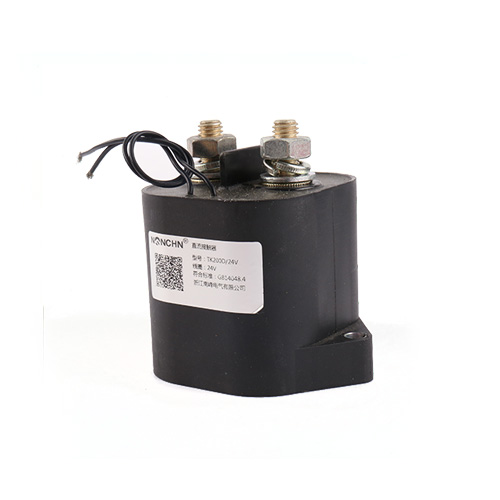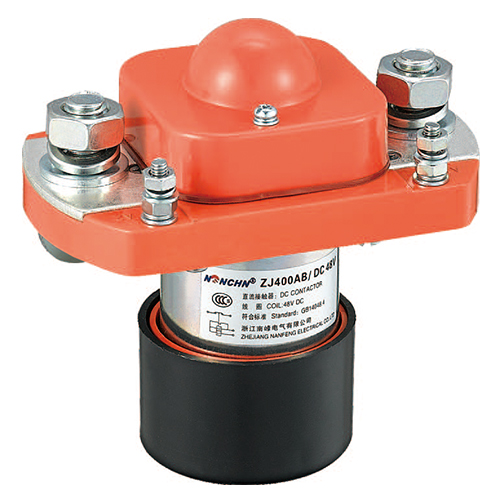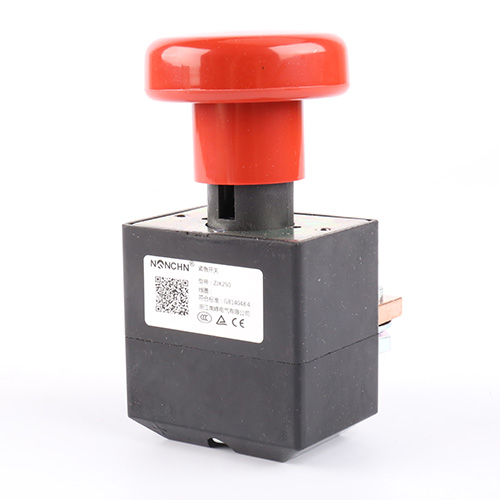

A forklift operator turns the key. Nothing happens—no click from the contactor panel. A maintenance technician replaces the DC contactor, but a week later, the same failure repeats. An engineer chasing a 24V control circuit finds that the contactor chatters and buzzes instead of closing cleanly. DC contactors fail in predictable ways, and most of the time, the root cause is not the contactor itself.
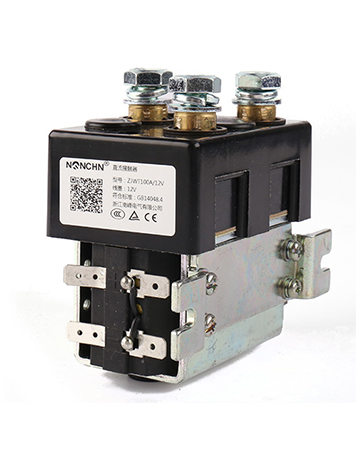
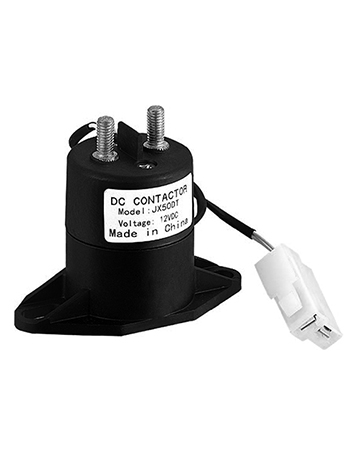
A DC Contactor is an electrically operated switch that uses a low-power control signal to open or close a high-current DC circuit. Unlike AC contactors that rely on current zero-crossing to extinguish arcs, DC contactors must actively force the arc to extinguish—typically using a magnetic blowout system. The ZJW100H-T is a 100A DC contactor designed for electric forklifts, battery vehicles, and industrial control systems, with coil options from 12V to 72V DC.
This guide walks through the three most common failure modes—insufficient coil voltage, contact welding from inadequate arc extinction, and mechanical debris—and gives you field-tested fixes that restore the contactor without replacing major assemblies.
What the Coil Tells You
The coil is the first place to look when a DC contactor fails to close or chatters. A 100A DC contactor like the ZJW100H-T has two key current stages: pull-in current (typically 1-2A) and hold-in current (typically 0.1-0.3A). For a 24V coil, pull-in may require 40W, dropping to 6W once closed. For a 12V coil, expect 14-17W pull-in and 24W for higher ratings.
Measure voltage at the coil terminals, not at the supply. Long control wires or undersized cables cause voltage drop under the high pull-in surge. If the coil receives less than 75-80% of its rated voltage, the contactor may not pull in fully, causing chattering and contact welding. Verify the coil supply voltage under load with the contactor energized. Many so-called “contactor failures” are actually voltage drop problems traceable to corroded terminals, loose connections, or undersized wiring.
Confirm the power source. A DC contactor used in a battery system may see voltage drop when the battery is heavily loaded. The ZJW series, designed for battery-powered vehicles, carries a temperature rise rating of ≤65K on outgoing terminals—excessive heating indicates the contactor is operating outside its design parameters.
Coil Resistance – The Overlooked Diagnostic
Every DC contactor has a specified coil resistance. For the ZJW100H-T, expect around 12-20Ω for a 12V coil, scaling with voltage squared. Use an ohmmeter to measure coil resistance at the terminals—open circuit means a burned coil; shorted or significantly low resistance indicates insulation breakdown. A 24V coil reading below 2Ω points to a shorted coil, while infinite resistance suggests an internal open. Compare your reading against the expected value from the datasheet. If the coil fails either check, replace the contactor—rewinding a DC contactor coil in the field is rarely cost-effective.
The Arc Extinction Problem
DC arcs do not self-extinguish. Each time the contactor opens under load, an arc forms between the separating contacts. Without proper arc suppression, the arc erodes the contact material and can weld the contacts closed after repeated operations. For a 100A DC contactor switching 80V, the arc energy can exceed 8,000 watts during the opening transient.
The ZJW100H-T uses a magnetic blowout system—a permanent magnet near the contacts produces a magnetic field perpendicular to the arc. The field forces the arc to stretch, lengthen, and cool, extinguishing it before contact damage becomes severe. This system is critical: without magnetic blowout, DC contactor contacts can fail in fewer than 1,000 operations, whereas a properly functioning blowout can extend life to 30,000 cycles.
Signs of blowout failure
If the permanent magnet is weakened, cracked, or the arc chute is damaged, the arc extinguishing capability degrades. Visual signs include heavy pitting, carbon deposits, or metal transfer between contacts. Replace the entire contactor if the blowout system is compromised—magnetic components are not field-serviceable.
Pre-charge and inrush
In battery systems, large capacitors at the controller input draw massive inrush current when the contactor closes. Without a pre-charge circuit, the inrush can weld the contacts within a few operations. For a 100A DC contactor, use a pre-charge resistor (typically 10-50Ω) to limit inrush to 10-20A for 50-100ms before the main contacts close.
Contacts Sticking or Welding? Here’s the Fix
If the contacts are welded closed, the load remains energized even when the coil is de-energized. This can rapidly drain the battery or overheat connected equipment. Weld failures come from two sources: excessive inrush current (fixed with a pre-charge circuit) or insufficient arc extinction. For the ZJW100H-T, rated for 100A at ≤80V DC, check that the load current does not exceed this rating. If the contactor is welded, cut power, disconnect the load, and manually separate the contacts—if they resist, replace the contactor. A welded contact set cannot be reliably repaired.
Mechanical Debris and Jamming
Even with good electrical performance, a DC contactor can fail mechanically. Dirt, metal filings, or corrosion on the armature or guide pins prevent the contacts from moving freely.
Symptoms of mechanical failure. The coil energizes (you hear a click or hum), but the contacts do not change state; the contactor feels “gritty” when manually actuated; visible debris or rust around the moving parts.
What to check. Remove the contactor and manually operate the armature with a non-metallic tool. The motion should be smooth and positive. Debris in the arc chamber can also interfere with contact movement. Blow out dust with compressed air (wear eye protection). If debris has entered the sealed chamber, replacement is the only option.
Proper torque values
Loose terminal connections cause heating and eventual failure. For a 100A DC contactor like the ZJW100H-T, torque main terminals to 8-12 N·m depending on lug material. Under-tightening leads to arcing and heat; over-tightening can strip threads. Use a calibrated torque wrench and record settings. The rated temperature rise on outgoing terminals is ≤65K—if the terminal exceeds this by a significant margin, suspect a loose connection.
Environmental Factors
The ZJW series is rated for operation from -25°C to +40°C. Below -25°C, the coil may not develop enough magnetic force to pull in; above 40°C, the coil’s insulation degrades faster, and contact resistance increases. For high-temperature environments or heavy-duty switching, consider a higher-rated contactor or forced-air cooling. The contactor also withstands 98% relative humidity at 25°C—but avoid condensation; moisture inside the housing accelerates corrosion and reduces insulation resistance.
What Technicians Ask About DC Contactors
Q: Why does my DC contactor close, but the load doesn‘t power up? A: The contacts may be open, but the coil is energized. Measure continuity across the main terminals. If the coil clicks but the contacts don’t close, the mechanical linkage is jammed or the contacts are welded open. If both coil and contacts are good, the load itself may be faulty. Voltage drop across the contacts should be less than 100mV at rated current—higher indicates contact degradation.
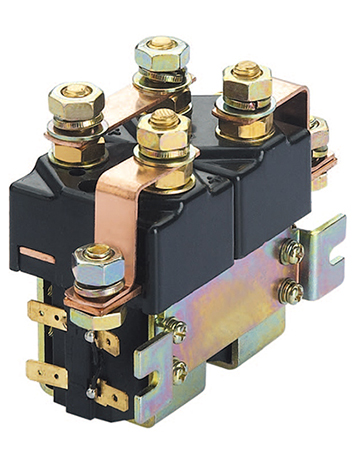
Q: Can I use a DC contactor for reversing (bidirectional) motor control? A: Yes, but you need two contactors: one for forward, one for reverse, with electrical interlocks. The ZJW series includes reversing configurations with a pair of contacts, rated for up to 48V DC. Ensure the contactor‘s coil voltage matches your control circuit. Never mechanically interlock two contactors unless the manufacturer explicitly approves it.
Q: What is the electrical life of the ZJW100H-T? A: Electrical life is rated at 10,000 operations at full load; mechanical life exceeds 300,000 cycles. For applications with frequent switching (e.g., DC motor reversing), the effective electrical life may be shorter due to increased arcing. Use a pre-charge circuit to extend contact life when switching capacitive loads. Electrical life is determined by contact resistance exceeding 100mΩ or visible contact degradation.
Q: How do I choose the right coil voltage for my application? A: Match the coil voltage to your control system‘s nominal voltage. For 12V systems, use a 12V coil; for 24V systems, use a 24V coil. The ZJW100H-T is available with coil voltages from 6V to 220V DC. If voltage fluctuations are common, add a voltage regulator or choose a coil with a wider operating range.
When a DC Contactor Needs Replacement
Replace the contactor immediately if any of the following are true: visible arc damage, melting, or carbonization on the contact surfaces; welded contacts (cannot be separated by hand); coil resistance out of specification (open or short); cracked or melted housing, indicating internal overheating; the contactor has exceeded its rated electrical life (typically 10,000 operations at full load); after any major short-circuit event where the contactor cleared a fault; or if the magnetic blowout system is damaged. Do not attempt to repair internal components—DC contactors are assembled to precise tolerances, and field disassembly often makes the problem worse.
ZJW100H-T – A DC Contactor Built for Battery-Powered Equipment
The ZJW100H-T DC Contactor from Nanfeng Electric is designed for battery-powered vehicles and industrial DC control systems. Key specifications include main contact rating of 100A at ≤80V DC, with coil options from 12V to 72V DC. The dielectric withstand voltage is 1,500V AC for 1 minute, ensuring safe isolation under fault conditions. Rated temperature rise on outgoing terminals is ≤65K, with ambient temperature range -25°C to +40°C. Electrical life is rated for 10,000 operations at full load, with mechanical life exceeding 30,000 operations.
The contactor uses a silver alloy contact material with a magnetic blowout system for arc extinction. Contact voltage drop is ≤100mV at 100A, which ensures minimal power loss in the main circuit. The ZJW100H-T is supplied with the Chinese 3C safety certification (GB/T 14048.4) and ISO 9001 quality management certification.
A DC Contactor that closes firmly, opens cleanly, and withstands the rigors of battery-powered applications keeps electric forklifts, pallet jacks, and industrial equipment running without unexpected shutdowns—and when failures do happen, a systematic diagnostic approach identifies whether the root cause is voltage, arcing, mechanical debris, or simple end-of-life wear.
→ Request a quote from Nanfeng Electric for the ZJW100H-T DC Contactor — Share your system voltage, load current (A), coil voltage (12V, 24V, 48V, or 72V), and whether you need a reversing configuration. Their technical team can recommend the correct contactor for your battery-powered application.