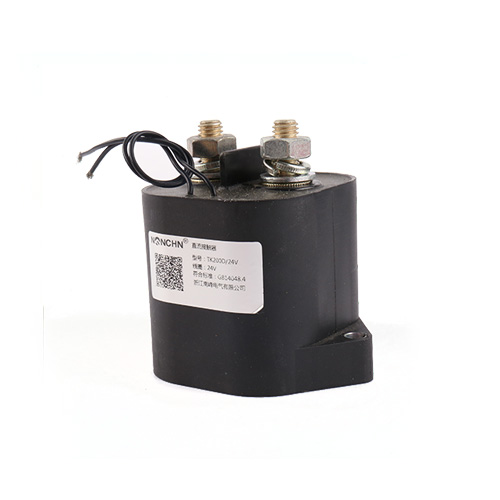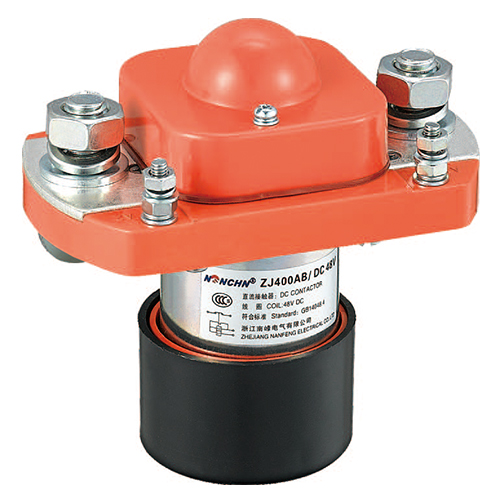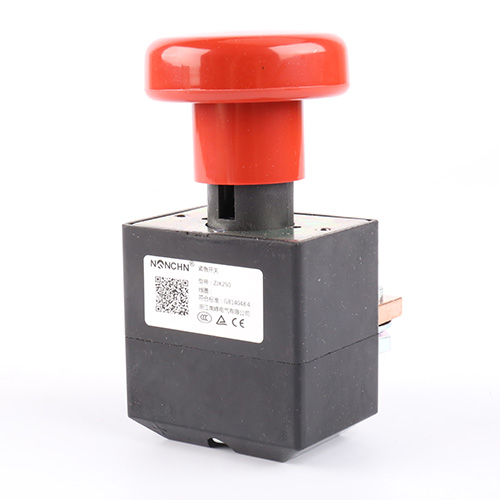

A forklift fleet manager in Vietnam watched a DC contactor weld its contacts after 15,000 cycles. The failure occurred when the operator turned the key off — the moment the contactor opened under load. The AC contactor on the same battery charger had run for years without failure. The difference was not the load. It was the arc.
A DC contactor interrupts direct current, which never drops to zero. The arc that forms when the contacts separate can sustain itself, burning the contact surfaces and often welding them together. A DC contactor must actively extinguish the arc using a magnetic blowout system. An AC contactor relies on the natural current zero crossing that occurs 100 or 120 times per second; the arc extinguishes on its own.
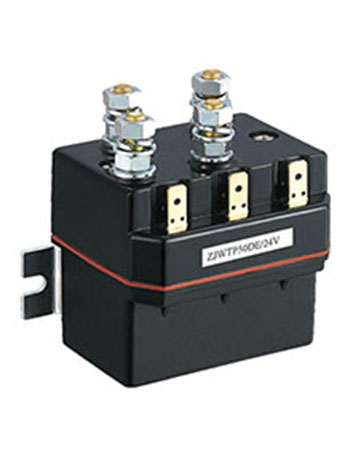
The ZJQ100-T DC contactor is a 100A device designed for battery‑powered systems including forklifts, electric winches, golf carts, and DC chargers. Its coil operates from 12V to 72V DC, and the contacts are rated for 80V DC continuous. The contact material is AgCuO(10)/Cu, a silver‑copper oxide composite that resists arc erosion better than fine silver. This article explains how the magnetic blowout system elongates the arc, why the AgCuO(10)/Cu contact material outlasts pure silver, and where the 30ms pick‑up time fits into a battery management system’s safety response window.
Magnetic blowout: why a DC arc needs to be pushed sideways
When the contacts of a DC contactor open under load, an arc forms between the separating surfaces. The arc is a plasma of ionized metal vapor. In a DC circuit, current flows in one direction, so the arc does not self‑extinguish.
The ZJQ100‑T uses a magnetic blowout system with a permanent magnet placed near the contact gap. The magnet's field is oriented perpendicular to the arc direction. When the contacts open, the arc is forced sideways, away from the contact surfaces and into an arc chamber. As the arc stretches, its voltage drop increases, and the available energy from the circuit can no longer sustain it. The arc extinguishes in milliseconds, and the contacts survive.
For a 100A load at 48V DC, the arc energy without blowout would be sufficient to melt the contact faces. The magnetic blowout reduces contact erosion by elongating the arc path and cooling it against the arc chamber walls. The result is a contactor that can withstand ≥2,000 electrical operations at rated load and ≥300,000 mechanical operations without the contacts welding or eroding beyond spec.
A fleet operator who replaced a non‑blowout DC contactor with the ZJQ100‑T saw the contact life extend from 15,000 to over 50,000 cycles on the same forklift. The blowout magnet required no external power and added no maintenance.
AgCuO(10)/Cu contacts: why copper oxide improves arc resistance
The contact material in the ZJQ100‑T is AgCuO(10)/Cu — a silver‑copper oxide composite bonded to a copper base. The silver‑copper oxide layer provides arc resistance; the copper base conducts heat away from the contact interface.
Silver‑tin oxide (AgSnO₂) is the RoHS‑compliant standard for AC contactors, but for DC interruption, the arc energy is higher and the contact must resist material transfer. The copper oxide in AgCuO(10) decomposes under the arc, forming a refractory layer that protects the underlying silver. The failure mode changes from sudden welding to gradual erosion, so the operator can predict end of life based on cycle count rather than waiting for a welded contact.
The contact resistance is specified at ≤80mV at 100A. For a 100A circuit, 80mV drop dissipates 8W — acceptable in a sealed enclosure. A contactor with 200mV drop would dissipate 20W, raising the internal temperature by 10‑15°C and accelerating insulation aging.
The contact is of the bridge type — a moving contact bar that bridges two stationary contacts, providing redundancy. If one stationary contact erodes faster than the other, the bridge still makes contact, and the contactor continues to operate.
The electrical life is rated at ≥20,000 operations under rated load. For a forklift that cycles 100 times per shift, 20,000 cycles represent 200 shifts — roughly 6‑12 months of operation, at which point contact erosion may degrade performance, and replacement is recommended. The mechanical life of ≥300,000 operations means the spring mechanism will outlast the contacts by an order of magnitude.
| Parameter | ZJQ100‑T Specification |
|---|---|
| Contact form | 1NO (single pole, normally open) |
| Contact voltage rating | ≤80V DC |
| Contact current rating | 100A continuous |
| Inrush current withstand | 7Ie (700A) for ≤1s |
| Contact voltage drop | ≤80mV at 100A |
| Contact material | AgCuO(10)/Cu |
| Electrical life | ≥20,000 cycles |
| Mechanical life | ≥300,000 cycles |
| Pick‑up time | ≤30ms |
| Release time | ≤50ms |
| Coil voltage options | 12V, 24V, 48V, 72V DC |
| Coil power | ≤38W at nominal voltage |
| Pick‑up voltage | ≤70% of rated coil voltage |
| Release voltage | ≥5% ≤40% of rated coil voltage |
| Insulation resistance | ≥100MΩ (at 500V DC) |
| Dielectric strength | 1500V AC for 1 minute |
| Ambient temperature | -25°C to +55°C |
| Protection rating | IP50 |
| Vibration resistance | 2.5g, 5‑50Hz |
| Shock resistance | 50g, 11ms half‑sine |
Data sourced from ZJQ100-T product specifications.
Coil voltage and pick‑up time: why a 48V coil pulls in at 33V
A DC contactor coil is sized for a specific voltage range. The ZJQ100‑T is available in 12V, 24V, 48V, and 72V DC coils. The pick‑up voltage is ≤70% of the rated coil voltage. For a 48V coil, the contactor will close when the coil voltage reaches approximately 33V.
This low pick‑up threshold ensures the contactor operates even when the battery voltage sags under load. A forklift battery at 80% state of charge may drop from 48V to 36V during acceleration; the contactor must still pick up. The release voltage is ≥5% and ≤40% of the rated coil voltage — wide enough to prevent nuisance drop‑out from voltage ripple but low enough to ensure the contacts open when the battery is disconnected.
The coil power consumption is ≤38W at rated voltage. For a 48V coil, that is about 0.8A. The holding current is lower than the pick‑up current because the armature gap is closed, reducing the magnetic circuit reluctance. A contactor that draws 0.8A at pick‑up may draw 0.5A once closed. For a battery‑powered system, the difference matters over long idle periods. The coil is designed for continuous duty, rated for continuous operation without overheating.
The pick‑up time is ≤30ms, and the release time is ≤50ms. In a safety circuit where the contactor must open before the battery disconnect switch trips, the 50ms release time is fast enough to prevent the disconnect from opening under load — a requirement for many battery management systems.
Why the release voltage window is wide
The release voltage is specified as between 5% and 40% of the rated coil voltage. A 48V coil will release somewhere between 2.4V and 19.2V. This wide window allows for manufacturing variation — different contactors from the same batch may release at different voltages but still meet spec. For a system designer, the release voltage is not a precise threshold. The control circuit must remove coil power completely to ensure the contactor opens, not rely on a specific drop‑out voltage.
The coil is designed for DC operation only. Applying AC voltage will cause the contactor to buzz and overheat. The terminal screws are M5, tightened to ≤2.5N·m; the contact terminals are M6, tightened to ≤7.0N·m. Over‑tightening can strip the threads or crack the ceramic housing.
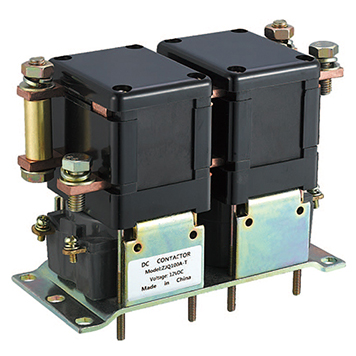
Environmental ratings: IP50 protection and 2.5g vibration tolerance
The ZJQ100‑T is rated IP50 — protected against dust ingress (5) but not protected against water (0). The contactor is designed for installation inside a control panel or battery box, not for outdoor exposure. For outdoor applications such as charging stations or marine winches, the contactor must be mounted inside a weatherproof enclosure.
The vibration tolerance is 2.5g from 5‑50Hz, and shock tolerance is 50g for 11ms half‑sine. These ratings meet the requirements for forklifts, golf carts, and industrial machinery. A forklift traveling over a warehouse floor sees vibration in the 10‑40Hz range; the contactor will not false‑operate or lose contact continuity. The moving contact is spring‑loaded to maintain contact force during vibration.
The ambient temperature range is ‑25°C to +55°C. At the upper end, the coil temperature rise (≤85K) must be added to the ambient. At 55°C ambient, the coil may reach 140°C — within the Class B insulation rating (130°C with margin) but near the limit. For installations in hot climates or enclosed panels, derating the continuous current or reducing the duty cycle may be required. At the low end, the coil pick‑up voltage increases slightly because the copper resistance decreases with temperature, but the ≤70% pick‑up threshold still applies.
The insulation resistance is ≥100MΩ measured at 500V DC. The dielectric strength is 1500V AC for 1 minute between the coil and contacts, and between the contacts and the frame. This rating is sufficient for 48V battery systems with a safety margin; for higher voltage systems (up to 1500V DC), a different contactor series would be required.
The mounting is any position — the contactor can be installed upright, sideways, or inverted without affecting performance. The moving contact is gravity‑independent; the spring returns it to the open position regardless of orientation.
How the ZJQ100-T DC contactor fits into a battery‑powered vehicle control system
Naidian (Zhejiang Naidian Electric Co., Ltd.) manufactures the ZJQ100‑T DC contactor for battery‑powered vehicles and industrial equipment. The contactor features a 1NO contact form, 100A continuous rating, AgCuO(10)/Cu contacts for arc resistance, magnetic blowout for DC arc extinction, coil voltages 12‑72V DC, ≤30ms pick‑up, IP50 protection, and CE certification.
A DC contactor that actively extinguishes the arc — using a permanent magnet to stretch and cool the plasma — survives the 100A DC interruption that would weld a fine‑silver contact closed. For a forklift fleet manager, a winch manufacturer, or a DC charger designer who has replaced one too many welded contactors, the ZJQ100‑T delivers the magnetic blowout, AgCuO(10)/Cu contact material, and fast pick‑up time that keep the battery circuit under control.
【Request a quote from Naidian】
Contact Naidian with your required coil voltage (12‑72V DC), continuous current (up to 100A), and application (forklift, winch, charger, or EV) to receive a ZJQ100‑T DC contactor specification and sample.