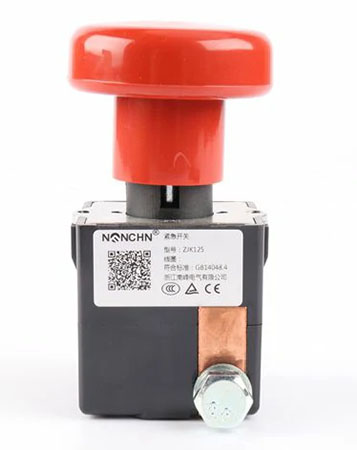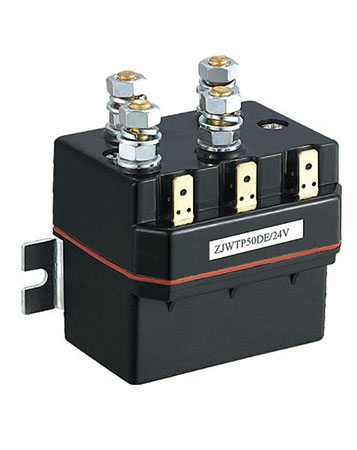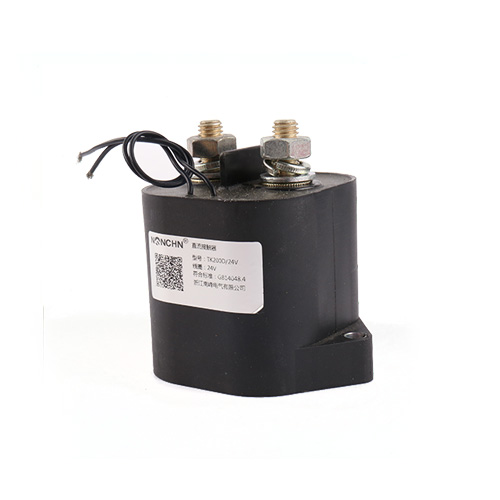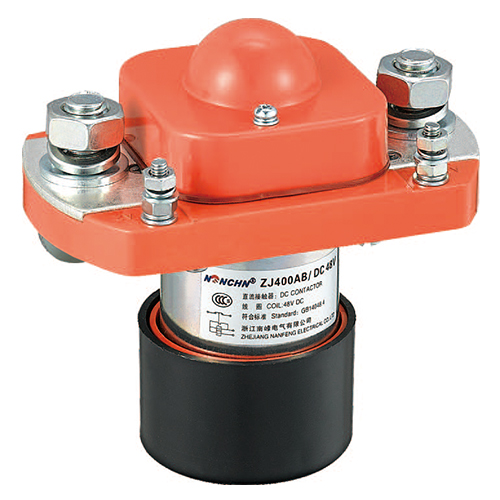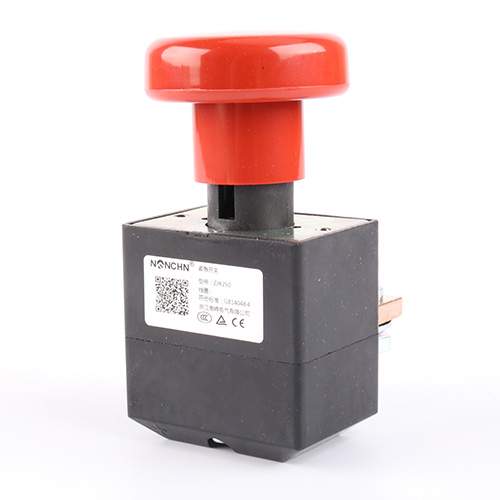

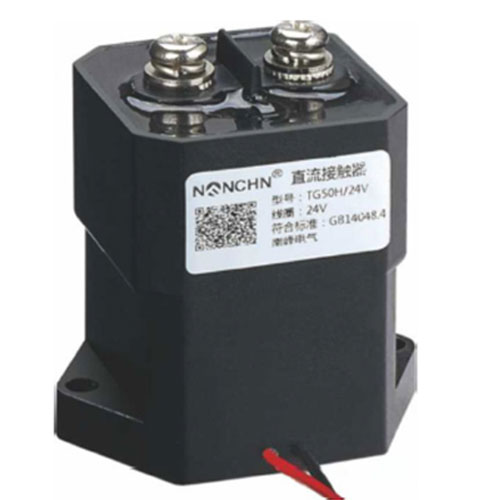
A black sealed case with two main terminals on top and a two-wire coil lead out the side, built to open and close a direct-current power feed under the case. DC Contactor construction here keeps the contact set inside a sealed body rather than an open relay, so the switch sits on battery-powered machines where dust, damp, and vibration reach the panel. Here's what the TG50H switches, how its ratings read, and how it mounts.
What the Contactor Switches and Where
Which Vehicles and Systems Use It?
The listed applications cover the power supply of a storage battery car, electric forklift, electric winch, electric car, excavator, air conditioner in vehicle, and power source. Beyond vehicle loads, it's also listed for automation systems, power systems, and communication equipment, where a reliable on-off switch for a DC feed is needed. The described traits are fast response, high reliability, and wide adaptability across those settings.
What Are the Main Contact Ratings?
The main contacts are one pair of bridge-type normally open (NO) contacts, rated 750V DC at 50A. The contact material is AgCuO(10), and the voltage drop across the contacts is ≤100mV at carrying current. The contact pair brings the battery feed through terminal positions 1 and 2, while the coil positions A1 and A2 drive the pull-in.
What Coil Voltage Drives It?
The coil specification covers 9-36V DC, with a coil resistance of 6.0Ω at 1±10% measured at 20℃. Coil DC power splits between a start current of ≤1.0 and standby power of ≤4.0W. That wide coil range matches the common 12V and 24V vehicle and control supplies without a separate coil adapter for each.
How the Sealed Case Protects the Contacts
IP67 Housing Across the Temperature Range
The unit is fully sealed and carries a protection grade of IP67, which keeps the contact mechanism away from dust and water ingress in machine bays and outdoor installations. Working temperature runs -40℃ to +85℃, and mounting altitude stays at ≤2km. The case also holds up to listed vibration — sine shock at 2.5g across 5-50Hz — and impact at 50g for 11ms half sine, the kinds of shock a forklift, winch, or excavator frame transmits during operation.
What the Electrical Performance Numbers Mean
Pickup and Release
The pickup voltage is ≤75%Us, and the release voltage is listed at ≤7.0. Timing is short: pickup time ≤30ms, release time ≤20ms, so the contact closes and opens quickly rather than dragging through a slow pull-in. Acting frequency is listed at ≤1Hz, and working duty is continuous, matching a switch that sits in a circuit for long periods rather than cycling rapidly.
Drop, Life, and Breaking Current
Insulation resistance holds ≥100MΩ, and dielectric withstand is 2200VAC at 50Hz for 1 minute between contacts and coil, with no breakdown. Rated-load electrical life is listed at ≥2000 times at 900V 30A, ≥2000 times at 750V 50A, and ≥5000 times at 450V 50A. Maximum breaking current is 500A at 320VDC, one time, and instantaneous maximum current is 350A for ≤1s. Terminal temperature rise stays ≤65K, and coil temperature rise ≤85K.
How the Model Code and Order Are Read
Decoding TG50H
The model breaks into four positions: product model, main contact rated current in amps, presence of the energy-saving circuit board, and coil rated voltage in V DC. In the order example TG50H/(9-36)V, the main contact is 50A at DC750V, the coil is 9-36V, and the contact set is one pair of bridge NO contacts. The wiring diagram keeps main contacts and coil separate: 1 and 2 switch the power feed, A1 and A2 connect the coil supply.
The TG50H Specification at a Glance
What the Product Page Lists Up Front
The table collects the contact rating, coil data, performance numbers, and environmental conditions exactly as listed, so a designer can match the contactor to the DC load before an enquiry.
| Item | Detail |
|---|---|
| Model | TG50H |
| Contact type | One pair bridge-type NO contacts |
| Main contact rating | 750V DC, 50A |
| Contact material | AgCuO(10) |
| Contact voltage drop | ≤100mV |
| Coil voltage | 9-36V DC; coil resistance 6.0Ω ±10% |
| Coil power | Start current ≤1.0; standby ≤4.0W |
| Pickup / release | Pickup ≤75%Us; release ≤7.0; ≤30ms / ≤20ms |
| Max breaking current | 500A at 320VDC, 1 time |
| Instantaneous max current | 350A, ≤1s |
| Protection / duty | IP67; continuous duty |
| Working temperature | -40~+85℃; altitude ≤2km |
| Related frames | TG100H, TG150H |
What the Mechanical Conditions Cover
The mechanical section covers mounting and endurance rather than the contact rating: free mounting, M5 outgoing terminals torqued to ≤5.5N·m, a high-temperature insulated multi-stranded copper coil lead, vibration and impact tolerance, and the temperature and altitude limits above. These are the checks that decide whether the sealed body will hold up on the machine frame through the operating season.
How It Mounts on the Equipment
Free Mounting on the Frame
Mounting method is listed as freely, so the contactor bolts to a bracket or panel rather than clipping to a DIN rail. The outline drawing gives the body at about 59mm high and 54mm wide at the base, with mounting holes 2-Φ5×8 and the terminal spacing shown on the dimension sheet. The coil lead is high-temperature insulated multi-stranded copper wire, routed out the case to the control supply, so the mounting position should leave room for the lead to reach the coil terminals without strain.
Nonchn, the Contactor, and the Enquiry
What the Manufacturer Supplies
NONCHN supplies the TG50H Fully Sealed High Voltage DC Contactor as a sealed contact switch for vehicle and equipment DC feeds, with the contact rating, coil range, and environmental protection listed above. The TG series range also covers the TG100H and TG150H frames for higher current loads that outgrow the 50A unit, and the same sealed case format across the family.
What to Send With the Enquiry
Send these so the frame and coil can be selected on the first pass:
- Load voltage and continuous current of the DC circuit the contactor switches.
- Coil supply voltage: 9-36V range, or the specific control supply in the machine.
- Duty: continuous or cycling, and the expected switching frequency.
- Environment: temperature range, exposure to dust or water, vibration level on the frame.
- Mounting: bracket space, terminal size, and coil lead routing available.
A DC Contactor selection is settled by the load current and the coil voltage first, so those two details narrow the frame before the environmental and mounting checks are done.
Send the Load Voltage and the Coil Voltage
What to Put in the Message
Put the DC load voltage, the continuous current, and the coil supply in the first note. Those three decide the frame size and coil version; duty and mounting follow after.
Send them through our request a quotation form and we'll come back with a DC Contactor matched to your battery load, coil supply, and machine mounting.