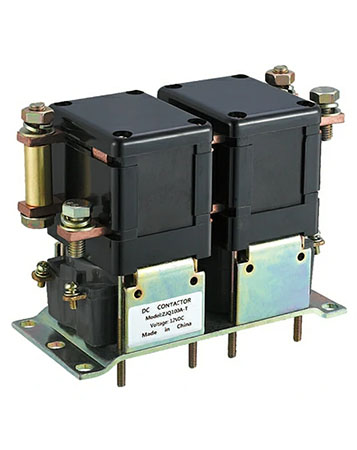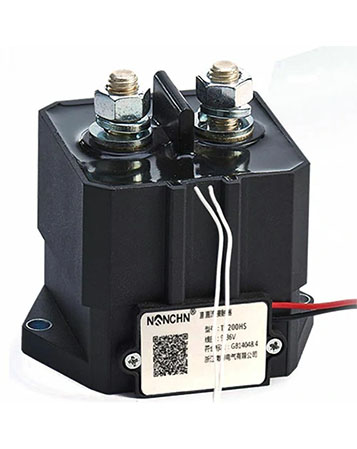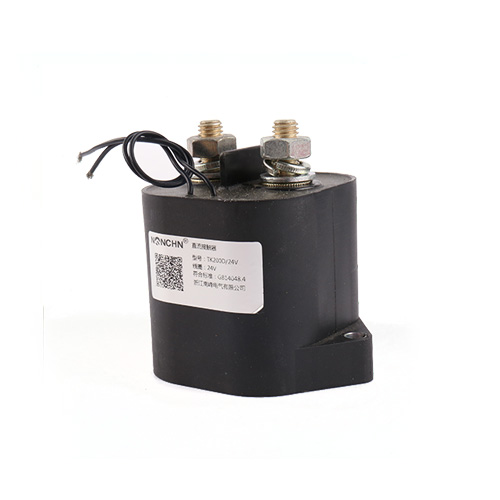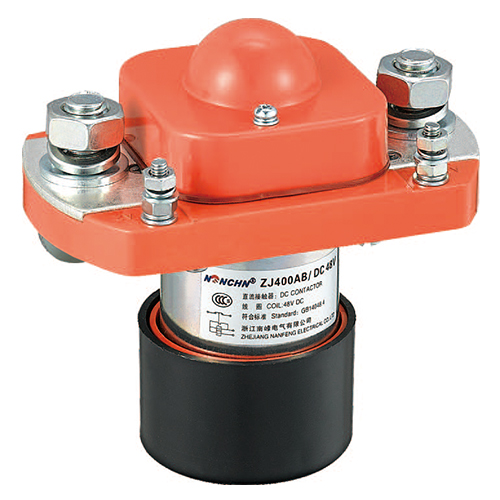

A DC Contactor in a battery vehicle or a base-station power shelf has to do more than close a circuit—it has to reverse direction, survive vibration, and stay sealed against dust and moisture. You'll see what the ZJWT P50's ratings actually mean in those conditions and where it fits.
What Questions Come Up Before Choosing a 50A Unit?
Is 50A enough for a reversing application?
The rated current of the contacts is 50A, with an instantaneous maximum closing current of 7Ie for up to 1 second. That short-time margin matters in reversing duty: when the contactor changes direction on a motor or winch, the inrush can briefly exceed the steady rating. The 7Ie window covers that surge without sizing up to a larger frame.
Why does IP67 matter on a contactor?
The protection grade is listed as IP67. In a battery vehicle, an electric forklift, or a base-station cabinet, dust and moisture aren't cosmetic problems—they're the path to contact resistance drift and coil failure. A sealed housing keeps the contact chamber and coil assembly isolated from the working environment, so the electrical ratings stay meaningful over time rather than degrading with contamination.
The Commutation Contact and What It Switches
The contact type is a set of commutation contacts, and the rated voltage of those contacts is DC48V or less. This isn't a general-purpose normally-open contact—the commutation arrangement is what lets the contactor reverse the polarity or direction of a DC load. The applications listed on the page follow directly from that function: battery cars, electric forklifts, electric winches, electric cars, excavators, and air conditioners in vehicles.
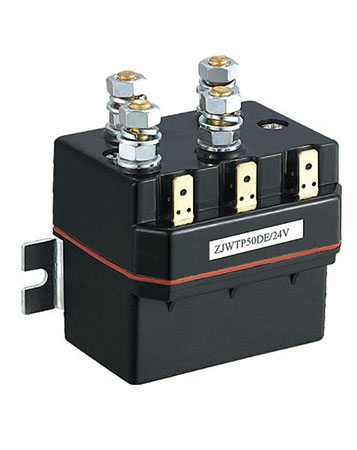
The ZJWTP50DE/24V variant extends the same contact set to a different load profile: it's used in the EPS power supply of a communication base station, and the contacts can also carry AC loads at 380V, 220V, and 110V. That dual DC/AC capability means the same contactor family can serve both the DC side of a battery system and the AC distribution inside a base-station cabinet, reducing the number of distinct part numbers a panel builder has to stock.
What the contact material brings to the duty
The contact material is AgCuO(10)/Cu. Silver-copper oxide is chosen for DC switching because it resists welding and arc erosion better than fine silver alone under repeated make-break cycles. The copper backing carries the current, and the silver oxide face handles the arc at the moment of opening—the same division of labor that appears in DC-rated contact systems generally.
Coil, Timing, and the Electrical Envelope
The coil voltage options cover the common battery and control voltages: 12V, 24V, 48V, and 72V DC are listed, with corresponding coil resistances in the conversion table. Pickup voltage is ≤75% Us, and release voltage sits between ≥5% Us and ≤40% Us. In a vehicle or a base-station shelf, those thresholds determine whether the contactor pulls in reliably when the battery sags under load and drops out cleanly when the control signal is removed—rather than chattering in the middle of a start sequence.
Coil power consumption is ≤10W long-term and ≤28W short-term. Pickup time is ≤30ms, and release time is ≤50ms. The table below collects the electrical ratings that matter for a specification review.
| Parameter | ZJWT P50 rating |
|---|---|
| Contact type | One set of commutation contacts |
| Rated contact voltage (DC) | ≤48V |
| Rated contact current | 50A |
| Instantaneous max closing current | 7Ie, ≤1s |
| Contact voltage drop | ≤100mV |
| Insulation resistance | ≥100 MΩ |
| Dielectric withstand | 1500V, 1 min, no breakdown |
| Coil voltages | 12V, 24V, 48V, 72V DC |
| Pickup voltage | ≤75% Us |
| Release voltage | ≥5% Us, ≤40% Us |
| Pickup / release time | ≤30ms / ≤50ms |
| Electrical life | ≥2 × 10⁴ cycles |
| Mechanical life | ≥30 × 10⁴ cycles |
| Protection grade | IP67 |
Why voltage drop and insulation resistance belong together
A contact voltage drop of ≤100mV at 50A points to a low-resistance joint inside the sealed chamber. Insulation resistance of ≥100 MΩ and a 1500V dielectric withstand confirm the coil-to-contact and contact-to-contact barriers hold up. In a 48V DC system, the voltage drop matters for heat at the terminals; the insulation numbers matter for safety separation between the control coil and the load circuit.
Sealing, Vibration, and the Working Environment
The working temperature range is -25°C to +55°C, and the mounting altitude limit is 2km. Vibration is rated for sine shock at 2.5g across 5–50Hz, and impact is rated at 50g for 11ms half-sine. Those aren't laboratory formalities—they describe a contactor mounted on a forklift chassis or inside a winch housing, where the structure transmits road shock and motor vibration directly into the coil and contact assembly.
-
Terminal torque: M10 outgoing terminal, not more than 4.5 N·m
-
Coil wiring insert: 0.8
-
Mounting: freely mounted, with no single prescribed orientation
-
Temperature rise: outgoing terminal ≤65, coil ≤85K
What free mounting means for a retrofit
A contactor that doesn't require a fixed orientation is easier to fit into an existing battery box or cabinet. The installer can route the coil leads and load cables around what's already there, rather than rebuilding the mounting plate to suit the contactor. For aftermarket and retrofit work, that flexibility often decides whether a job takes an hour or a day.
Where the ZJWT P50 Earns Its Place
The ZJWT P50 DC Contactor from dc-contactor.com is built around the duty the page describes: reversing 50A DC loads on battery cars, electric forklifts, winches, excavators, and vehicle air conditioners, with the ZJWTP50DE/24V variant extending into base-station EPS supplies and AC loads at 380V, 220V, and 110V. The 7Ie closing margin, AgCuO contact face, IP67 housing, and ≥30 × 10⁴ mechanical cycle rating are the details that let the same frame serve both a vehicle's traction circuit and a stationary power cabinet. For a system integrator or a fleet maintenance team, the practical value sits in the sealed construction and the reversing contact set—the contactor does the direction change and the environmental isolation in one part, rather than requiring a separate reversing assembly and an additional enclosure.
What to verify against your load profile
A 50A rating is a starting point, not a universal answer. Confirm the continuous current against the load's steady-state draw, the 7Ie margin against the inrush of a reversing start, and the coil voltage against the control supply's actual range. The release-voltage window and the pickup time deserve a look too—those determine whether the contactor drops out cleanly on a battery sag rather than hanging in an indeterminate state.
Let's Check the Ratings Against Your Circuit
Send over your load current, inrush profile, coil voltage, and mounting environment—we'll help you confirm whether the ZJWT P50 fits the duty or whether a different frame size serves the circuit better. Talk to dc-contactor.com about your DC Contactor requirements and get a rating-level answer before you commit to the bill of materials.