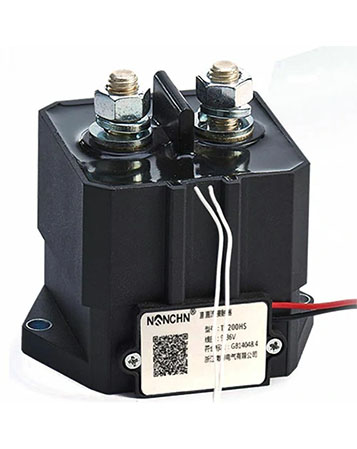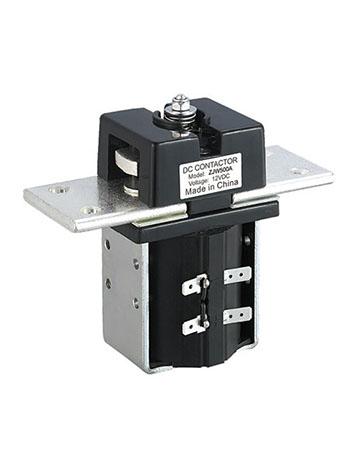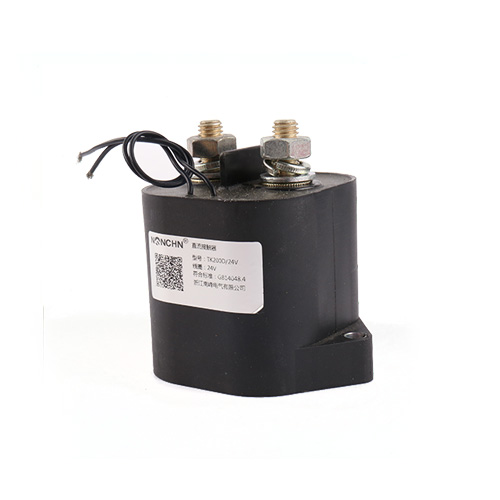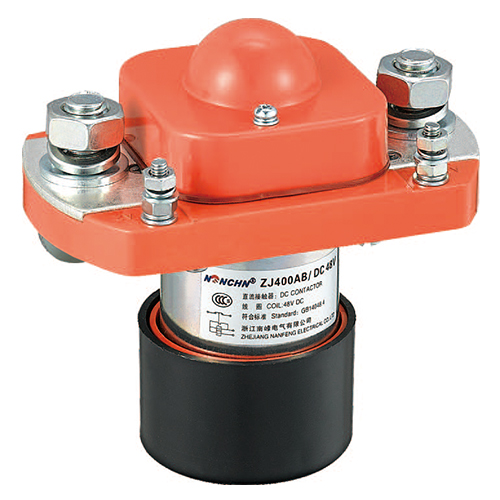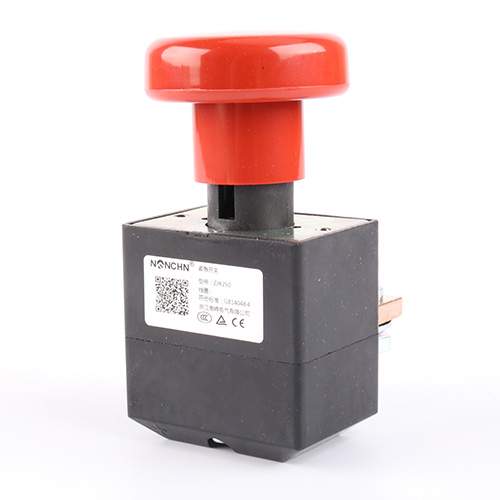

A ZJQ Series DC Contactor in the ZJQ100-T configuration switches up to 100A continuous at 80V DC, with a 7× rated current instantaneous closing capacity for inrush events. It uses a conversion contact set that carries the full load current and interrupts it without welding, with a voltage drop of only ≤80mV at 100A. This article explains how the conversion contact works, what the coil voltage options cover, and what to verify when you're specifying a DC contactor for a battery vehicle, forklift, or electric winch.
What Is a Conversion Contact Set?
Normally Open and Normally Closed in One Housing
The ZJQ100-T uses one set of conversion contacts—a contact configuration that includes both a normally open (NO) and a normally closed (NC) path in the same housing. When the coil is energized, the contact transfers from one state to the other, so the same device can make one circuit while breaking another.
That conversion function matters in battery-powered equipment where the contactor has to switch the power path and simultaneously signal the control system. Instead of wiring two separate contactors, the conversion set handles both functions in a single 100A-rated package.
Contact Material and Voltage Drop
The contact material is AgCuO(10)/Cu—a silver-copper oxide composite on a copper base. The silver phase provides low resistance, and the copper oxide phase resists arc erosion and welding. The voltage drop across the contacts is ≤80mV at 100A, which corresponds to roughly 8W of heat at the contact interface—low enough that the contactor doesn't become a hot spot in the circuit.
Which Coil Voltages Are Available?
12V, 24V, 48V, and 72V DC Options
The ZJQ100-T accepts coil voltages of 12V, 24V, 48V, and 72V DC. Those options cover the battery systems used in electric forklifts, electric vehicles, and winches. The coil resistance varies by voltage: a 12V coil measures 3.95Ω, a 24V coil measures 15.5Ω, a 48V coil measures 60.6Ω, and a 72V coil measures 136.4Ω at 20°C.
Higher coil resistance means lower holding current, which reduces the drain on the battery while the contactor is energized. The coil power consumption is ≤38W, which is modest for a 100A contactor and keeps the continuous duty cycle within the battery's capacity.
Pickup and Release Characteristics
The pickup voltage is ≤70% of rated, so the contactor pulls in reliably even when the battery voltage sags under load. The release voltage sits between 5% and 40% of rated, ensuring a clean drop-out without chatter at intermediate voltages. The pickup time and release time are both ≤50ms, fast enough for most battery vehicle and winch control sequences.
| Parameter | ZJQ100-T Specification |
|---|---|
| Contact type | One set of conversion contacts |
| Rated contact voltage (DC) | ≤80V |
| Rated contact current | 100A |
| Instantaneous max current | 7Ie, ≤1s |
| Voltage drop on contacts | ≤80mV (at 100A) |
| Coil voltage options (DC) | 12V, 24V, 48V, 72V |
| Coil power consumption | ≤38W |
| Pickup voltage | ≤70% Us |
| Release voltage | ≥5% Us; ≤40% Us |
| Pickup time | ≤50ms |
| Release time | ≤50ms |
| Mechanical life | ≥30×10⁴ operations |
| Electrical life | ≥2×10⁴ operations |
| Contact material | AgCuO(10)/Cu |
| Protection grade | IP50 |
| Working temperature | -25°C to +55°C |
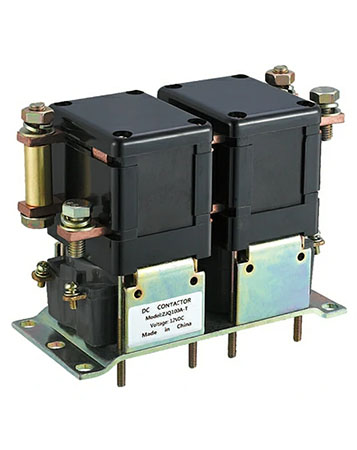
Where Does the ZJQ100-T Fit in Battery-Powered Equipment?
A ZJQ Series DC Contactor in the ZJQ100-T configuration is designed for storage battery cars, electric forklifts, electric winches, electric cars, excavators, and vehicle air conditioners. The common thread is a DC system that runs at up to 80V and carries 100A continuous, with a 7× rated current instantaneous closing capacity for inrush events.
In an electric forklift, the contactor sits between the battery pack and the traction controller. In a winch, it switches the motor power. In an excavator, it isolates the battery from the DC auxiliary systems. The conversion contact set can simultaneously switch the main power path and signal the control circuit, which simplifies the panel wiring compared with a two-contactor arrangement.
What Should You Check Before Selecting a ZJQ Contactor?
How do I match the coil voltage to my battery system?
Match the coil voltage to the control circuit, not the main power circuit. If the battery pack is 48V and the control circuit runs directly from the battery, use a 48V coil. If the control circuit runs through a DC-DC converter at 24V, use a 24V coil and switch the higher-voltage main circuit through the contacts. Connecting a 24V coil to a 48V supply will overheat and damage the coil.
What is the continuous duty rating?
The ZJQ100-T is rated for continuous operating duty. That means the coil can stay energized indefinitely without overheating, as long as the ambient temperature stays within the -25°C to +55°C range. Using an intermittent-duty contactor in a continuous application will burn out the coil.
What maintenance does the contactor need?
Inspect the contact faces for pitting and erosion during periodic maintenance. A contact face that has eroded significantly will have a higher voltage drop and will generate more heat. Check the coil terminals for tightness and verify the moving mechanism operates smoothly without binding. The ≥300,000 mechanical operations and ≥20,000 electrical operations define the service window.
Straight Answers on ZJQ DC Contactors
What's the difference between a conversion contact and a normally open contact?
A conversion contact includes both a normally open and a normally closed path, and the contact transfers between them when the coil energizes. A normally open contact only closes when the coil energizes and opens when the coil de-energizes. The conversion configuration lets the same contactor signal the control system while switching the main power path.
Can the ZJQ100-T be used on a 72V battery system?
Yes. The contact voltage rating is ≤80V DC, and the coil is available in a 72V option. A 72V battery pack that charges to a higher voltage should be checked against the 80V contact rating—if the maximum system voltage exceeds 80V, a higher-rated model is required.
What causes a DC contactor to weld shut?
Welding happens when the contacts close on a high inrush current and the contact faces fuse together before they can separate. The AgCuO(10) contact material resists welding, and the conversion contact structure distributes the closing force across the contact faces. But welding can still occur if the contactor is undersized for the inrush current or if the contacts are badly eroded. Match the 7Ie instantaneous rating to the load's inrush characteristic.
What is the purpose of the M8 and M5 terminal torque specifications?
The M8 contact terminal takes a maximum torque of 7.0 N·m, and the M5 coil terminal takes 2.5 N·m. Over-tightening can crack the housing or strip the threads; under-tightening creates a high-resistance joint that heats under load. Use a calibrated torque wrench during installation.
Let's Match a ZJQ Contactor to Your DC System
Share Your Voltage, Current, and Coil Requirement
A ZJQ Series DC Contactor in the ZJQ100-T configuration should match your system voltage, continuous current, and coil voltage—not the other way around. The ZJQ100-T DC Contactor from the ZJQ Series handles 100A at up to 80V DC, uses a conversion contact set with AgCuO(10)/Cu contacts, and is available with 12V, 24V, 48V, or 72V coils, with ≤50ms pickup time and ≥300,000 mechanical operations. If you're specifying a DC contactor for a battery vehicle, forklift, winch, or excavator, send us your voltage, current, and coil requirement — we'll help you confirm the right model before you order.