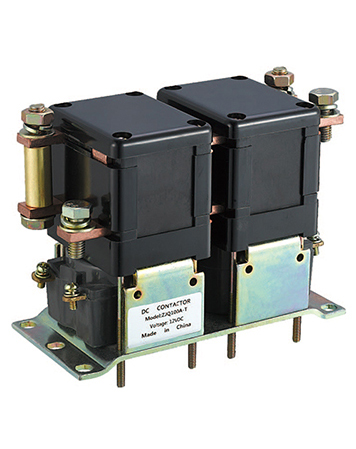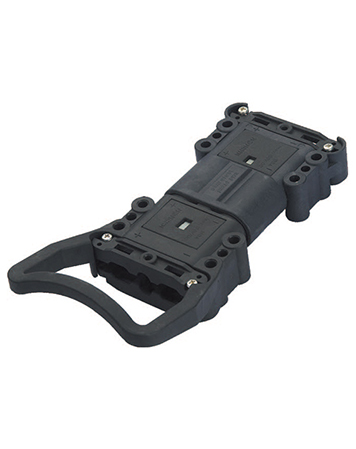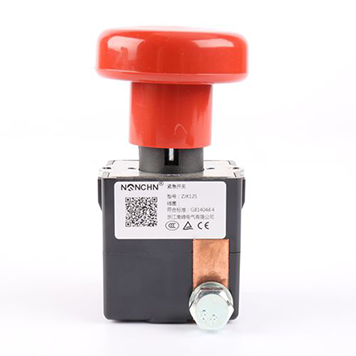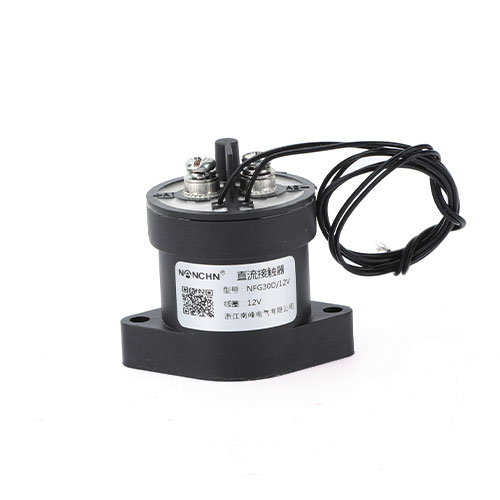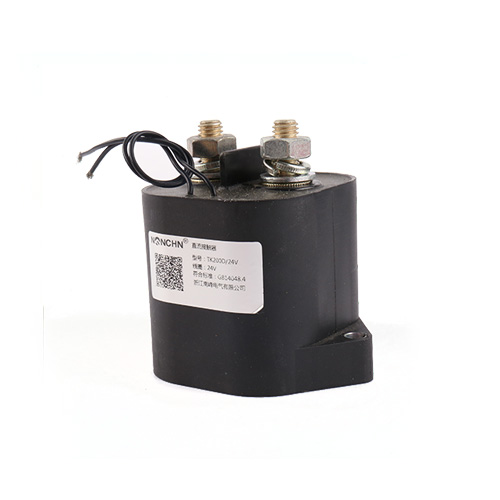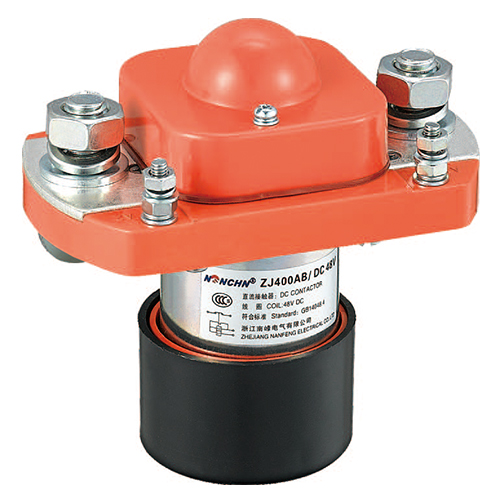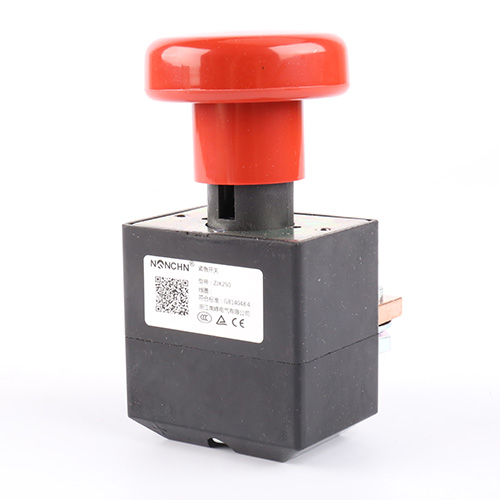

An electric forklift fleet manager saw the same failure pattern on three trucks. The contactor that switched the battery pack to the motor drive would occasionally weld its contacts shut, leaving the forklift stuck. The maintenance logs showed that the welds occurred when the operator turned the key off — the moment when the contactor opened the circuit under load, not when the motor was running.
A DC contactor faces a challenge that an AC contactor does not. Alternating current drops to zero 100 or 120 times per second; the arc that forms when contacts open extinguishes naturally at those zero crossings. Direct current never drops to zero. The arc that forms when a DC contactor opens under load maintains itself, burning hotter and longer, eroding contact material and often welding the contacts together.
The solution is not stronger springs or heavier copper. It is magnetic blowout and a sealed arc chamber. When the contacts begin to separate, the arc is pushed sideways by a permanent magnet, elongating until it cools inside a closed chamber filled with protective gas. This article explains why arc extinction is the central problem of DC switching, how sealed construction prevents contact oxidation, and where the 100‑400A rating fits different battery voltages.
Magnetic blowout: why a permanent magnet pushes the arc sideways
The arc that forms between separating contacts is a plasma of ionized metal vapor. In a DC circuit, current flows in one direction, so a magnetic field exerts a consistent force on the arc.
A DC contactor designed for high‑current breaking places a permanent magnet near the contact gap. When the contacts open, the arc is forced sideways, away from the contact surfaces. As the arc stretches, its voltage drop increases, and the available energy can no longer sustain it. The arc extinguishes tens of milliseconds faster than without blowout.
In an AC contactor, the current direction reverses every half‑cycle, so a permanent magnet would push the arc one way then the opposite way, offering no net gain. AC contactors rely on natural current zero crossing. A DC contactor must build blowout into its design. The magnet in the ZJWT series is rated for high temperatures, ensuring consistent blowout force even near a warm battery pack.
Sealed arc chamber: why open air allows contact oxidation
The arc not only erodes contact material but also creates oxides and nitrides from surrounding air. In an open contactor, these compounds deposit on contact surfaces, increasing contact resistance. A contactor that starts with a 0.5mΩ drop may rise to 2mΩ after 50,000 operations, dissipating enough heat to soften terminal insulation.
A sealed DC contactor isolates the contact chamber from ambient air. The chamber is filled with an inert or arc‑quenching gas — typically nitrogen or a hydrogen‑nitrogen mixture — that suppresses oxidation and absorbs arc energy more efficiently than air. The gas also prevents moisture ingress, which would cause hydrogen embrittlement of copper components.
The sealing also keeps out dust and salt spray. A DC contactor on an outdoor forklift exposed to condensation and salt will show green corrosion within a year if unsealed. A sealed unit remains unaffected.
| Feature | Open DC Contactor | Sealed DC Contactor |
|---|---|---|
| Contact oxidation | Progressive increase | Minimal |
| Arc extinguishing medium | Air | Nitrogen/hydrogen mix |
| Environmental sealing | IP00‑IP20 | IP67 |
| Contact voltage drop trend | Increases with cycles | Stable |
A sealed contactor also allows a smaller contact gap, reducing the coil work, lowering holding power, and speeding response.
Contact materials for 100‑1500V DC
A contactor rated for 100V DC and one rated for 1500V DC use different materials. Silver‑tungsten (AgW) and silver‑tin oxide (AgSnO₂) are common for high voltages because tungsten and tin oxide resist welding. For lower voltages, pure silver offers lower resistance but higher welding risk.
The ZJWT series uses AgCuO(10)/Cu composite contacts. The copper base draws heat away from the arc zone. The 10% copper oxide improves arc resistance without raising contact resistance significantly. Contact voltage drop is kept below 100mV at rated current, reducing power dissipation inside the sealed chamber.
For a 400A contactor switching 200V DC, a 0.1mΩ drop dissipates 16W. In a sealed chamber, that heat must be conducted through the housing. The AgCuO(10)/Cu combination balances low resistance with thermal management.
Why bidirectional rating matters for battery charging
A battery contactor in an electric vehicle must carry current in both directions: from battery to motor (discharge) and from charger to battery (charge). Many DC contactors are polarity‑sensitive because their blowout magnet works only when current flows one way. The ZJWT series is bidirectional, with a magnet design that blows the arc away from contacts regardless of current direction. For a charger that applies reverse voltage during the charging cycle, that bidirectional rating prevents the contactor from failing on the first charge.
Coil voltage range and power consumption
A contactor that draws 10W from a 24V battery will drain the battery over a weekend if it stays energized. The ZJWT series coil is available from 12V to 72V DC, with pickup power optimized to minimize holding current after closure. Typical holding power is under 3W.
The coil is designed to operate from a battery that can sag under load. For a 48V pack that drops to 36V during motor acceleration, the contactor must still pull in reliably. The voltage range for pickup is specified at 75‑110% of nominal. A 48V coil will close at 36V and stay closed down to 24V.
Coil suppression is built in. A freewheeling diode or varistor across the coil terminals is not required for DC switching of the ZJWT series, simplifying the control circuit in a battery management system.
Mechanical and electrical life
A DC contactor in a forklift may cycle hundreds of times per shift. The ZJWT series is rated for ≥300,000 mechanical operations (no load) and ≥30,000 electrical operations at rated load. For a truck that cycles 100 times per day, 30,000 operations is about 300 days of operation — roughly one year. At that point, contact erosion may degrade performance, and replacement is recommended.
The mechanical life tests the spring mechanism. The electrical life tests the contact material. In a sealed contactor with magnetic blowout, the electrical life at full rated current is typically 20‑50% of the mechanical life, depending on the load inductance. A resistive load (heater) is easier on contacts than an inductive load (motor). For a motor load, derate the electrical life by half.
How a sealed DC contactor fits into a battery system
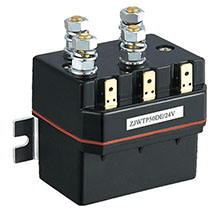
The ZJWT series sealed DC contactor is manufactured by Naidian (Yueqing Naidian Electric Co., Ltd.). The contactor is rated for 100‑400A continuous, with coil voltages from 12V to 72V DC, dielectric strength of 1500V, and IP67 sealing. It is used in electric forklifts, golf carts, winches, solar battery banks, and DC charger stations.
For a DC contactor that prevents contact welding through magnetic blowout and sealed arc chamber, the ZJWT series delivers AgCuO(10)/Cu contacts, ≤100mV drop, bidirectional rating, and IP67 sealing for harsh battery environments.
【Request a quote from Naidian】
Send Naidian your battery voltage (12‑72V DC), continuous current (100‑400A), and load type (motor, charger, or resistive) for a ZJWT series DC contactor specification.